Latest News Updates

img
01 March 2026
PRESIDENT MUSEVENI COMMITS SHS5BN TO CREATIVES, URGES YOUTH TO JOIN POVERTY FIGHT AT JAZZ WITH JAJJA SECOND EDITION

President Yoweri Kaguta Museveni and the First Lady, also the Minister of Education and Sports, Maama Janet Kataaha Museveni today hosted the second edition of Jazz with Jajja at their Kisozi farm in Gomba District. The event brought together a number of content creators, journalists, digital entrepreneurs, and social media influencers for a deep reflection on Uganda’s economic transformation and national values. Before the formal discussion, President Museveni took the youth on a tour of his farm, showcasing his herds, including Ekyigondo, now numbering over 700 cows originally belonging to his late mother, Kokundeka, for ghee production. He emphasized the importance of preserving the legacy of forefathers and passing it on to the next generation. The Ranch Edition, coordinated by Mrs. Natasha Museveni Karugire, brought together young Ugandans, many of whom shared stories of rising from difficult beginnings through digital enterprise. The inaugural edition took place on January 4, 2026. During the meeting, President Museveni also pledged Shs5 billion in support to organized content creators, describing them as an important layer in Uganda’s evolving economy. Responding to a request from YouTuber Isaac Katende, popularly known as Kasuku, on how digital influencers can formally collaborate with the government, the President described the sector as a modern evolution of traditional advertising. “What you are talking about is not something new. In the past, companies spent money on television and radio advertising. Now a layer of operators has come up using social media as an easier way of communication to package and present products to consumers,” he said. “If you are organized, we shall support you. If it is a combination of sales and entertainment, that is fine. I am glad to see our young people putting up that layer of promoters. We shall support you both in improving communication technology and operationally.” President Museveni also underscored the contribution of content creators in the new economy. “You are adding something different. It used to be an advertisement on radio and television. Now you have used the internet to combine celebrity with promotion and link it with other sectors.” He framed the discussion within what he called Uganda’s “whole battle”, moving citizens from poverty into productive economic participation. “I have heard that many of you were born in difficult circumstances. There are many like that. The question is: how can the country deal with that?” he inquired. The President explained that the government's long-standing strategy has been to involve as many Ugandans as possible in the four wealth creation sectors. “Now about 70 percent have joined the money economy. Those will help us deal with the remaining 30%. In this new kisanja, we must fight poverty because poverty is the biggest problem,” he said. He emphasized that financing has been deliberately taken closer to citizens through the Parish Development Model (PDM), Emyooga, ghetto funds and boda boda funds. “We have made sure the money is near the people. PDM is in the parish; in towns it is in the wards. Go and join the SACCOs. They are open to everyone above 18 years.” He revealed that the government injects Shs100 million per parish annually totalling Shs500 million per parish over five years, creating what he described as “parish banks.” For creatives specifically, he confirmed direct intervention. “For the creatives, we are going to put money in your own SACCOs. We already have billions with the musicians. Now we are supporting you as well.” He reiterated that science and technology remain the primary drivers of transformation. “The primer of change in human society is science and technology,” he said. “Without it, you cannot transform society.” He concluded by thanking the organizers. “I thank Natasha for coordinating you and bringing you here. I thank Maama for coming to support me at this event. God bless you all.” In her comprehensive address, Maama Janet urged young Ugandans to rediscover their identity, embrace faith and take responsibility for transforming their country. “It is important that we celebrate being Ugandan. Africa has failed to develop because it always looks to other countries to develop it, to change it or to do things for it, yet there are jobs here.” She expressed concern about young Africans risking their lives abroad while opportunities exist at home. “We must start by being proud of being Ugandan. All the other things will come from knowing that Uganda depends on us to develop it,” she said. Maama Janet cautioned against identity erosion, urging young people to value who they are and where they come from. “When you see Ugandans trying to change themselves to look like others, just think,” she said, emphasizing that confidence in national identity is foundational to transformation. On education reform, she spoke at length about Uganda’s new competency-based curriculum, describing it as a shift from passive learning to active engagement. “Our young people now enjoy being in class, asking questions and doing their own projects. Teachers are becoming facilitators. Education should liberate, not keep us captive.” She also contrasted education rooted in colonial philosophies with an approach that empowers African identity and critical thinking. “When you educate a person properly, you liberate your country,” she said. The First Lady further highlighted the government's growing investment in sports, noting that structured planning has replaced past improvisation. “In the past, students would go for national competitions without accommodation or food,” she said. “Now we plan. We select which teams to fund as a nation because we cannot fund all at once.” Although the national budget must address multiple priorities, Maama Janet assured participants that sports development is steadily improving as resources increase. Drawing on faith, she encouraged discipline and purpose. “Before you were in your mother’s womb, God knew you. Those who discipline their lives will fulfil their purpose.” She urged the youth to reject divisions based on tribe or religion and to work together. “If we hold hands as Ugandans and work together, our country will be unstoppable.” Among the participants was Ms. Jackie Arinda, a young entrepreneur who runs a coffee business using social media platforms. “I sell my coffee on TikTok, X and Instagram,” she said. “I go to the roastery, roast my coffee, take it home and market it directly on my social media platforms.” Ms. Arinda noted that digital platforms have enabled her to reach customers beyond her immediate location and build a brand without relying on traditional distribution channels. She added that she had previously benefited from the National Social Security Fund (NSSF), which helped strengthen her financial footing. However, she raised concerns about skills gaps and emerging technologies. “What policy changes can enable Ugandan businesses to use new technologies like AI and drone systems?” she asked. “As much as we advertise, we are not yet skilled to the required standard.” In response, President Museveni welcomed the innovation demonstrated by young entrepreneurs. “We shall support you to continue improving the technology of communication and also give you operational support,” he said. Delivering a vote of thanks, Ms. Pamela Ankunda said the central message of the engagement was patriotism and strategic security for Uganda and Africa. “The biggest takeaway is the love of Uganda and the strategic security of Uganda and Africa,” she said. “When you love Uganda, you understand that this event was teaching us the values of our country.” She thanked the First Lady for being “a woman of faith and valor” to the women of Uganda, recalling her declaration in Karamoja that the region would grow its own food “not by anyone’s power, but by the mighty power of God.”

img
27 February 2026
PRESIDENT MUSEVENI RECEIVES CREDENTIALS FROM SIX NEW AMBASSADORS

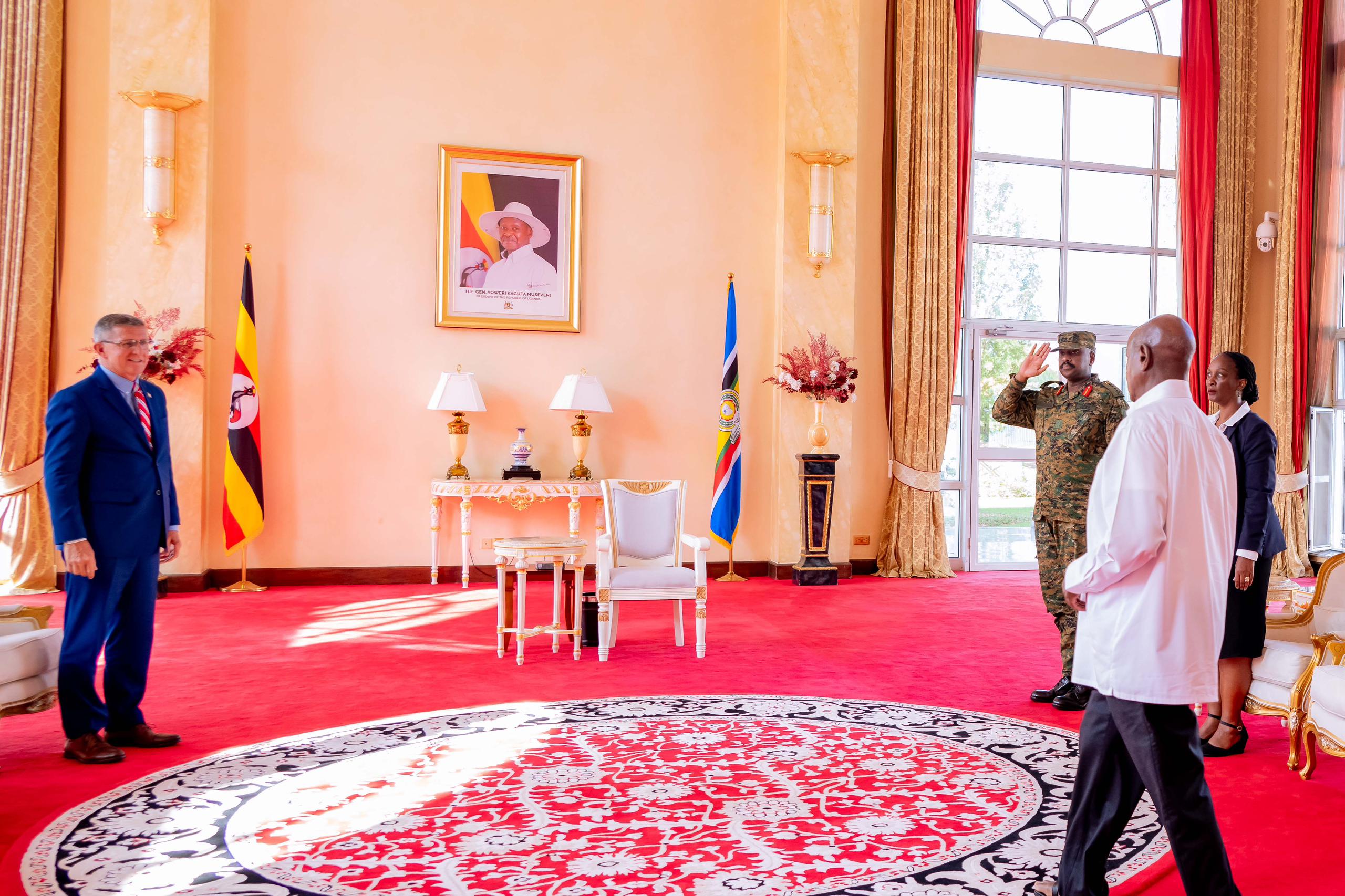
President Yoweri Kaguta Museveni has today received Letters of Credence from six Ambassadors-designate accredited to the Republic of Uganda at State House Entebbe. The Ambassadors who presented their credentials are: H.E. Mr. Ahmed Mohammed Abdulrahman Abdullah Al-Zweidi, Ambassador-designate of the State of Qatar H.E. Mr. Juan Humberto Macìas Pino, Ambassador-designate of the Republic of Cuba H.E. Mr. Seddiki Nafaa, Ambassador-designate of the Sahrawi Republic H.E. Mr. Gideon Behar, Ambassador- designate of the State of Israel H.E. Mr. Jaime Moreno Bau, Ambassador-designate of the Kingdom of Spain H.E. Mr. Màrio De Azevedo Constantino, Ambassador-designate of the Republic of Angola President Museveni welcomed the envoys to Uganda and reaffirmed the country’s commitment to strengthening bilateral relations and expanding cooperation in areas of mutual interest, including trade, investment, technology transfer, education, and regional stability. He emphasized that Uganda remains open to partnerships that promote value addition, economic transformation, and shared prosperity for the people of Uganda and the respective countries. The President wished the Ambassadors successful tenures and assured them of Uganda’s support in the execution of their diplomatic duties.

img
26 February 2026
PRESIDENT MUSEVENI HOSTS CHARLENE RUTO

President Yoweri Kaguta Museveni today hosted Charlene Ruto and her team at State Lodge, Nakasero. The meeting focused on strengthening regional cooperation and advancing value addition in the leather industry as a driver of Africa’s economic transformation. Welcoming Ms. Ruto, President Museveni expressed satisfaction with her interest in investing on the continent, emphasising that value addition remains critical to creating jobs and retaining wealth within Africa. “Africa must process its raw materials locally. How do we create jobs for our young people if we continue exporting raw materials and importing finished goods? That is where there is a big hemorrhage,” the President said. He reiterated his long-standing position that regional collaboration and industrial growth are essential for sustainable development. On her part, Ms. Ruto congratulated President Museveni upon his recent electoral victory and briefed him on her family’s long-standing involvement in business and manufacturing in Kenya. She noted that her team is keen on strengthening regional supply chains and deepening cooperation with Uganda as part of broader efforts to promote intra-African trade. Ms. Ruto also disclosed that she had earlier met with Uganda’s Chief of Defence Forces to discuss further avenues of cooperation and partnership.

img
24 February 2026
PRESIDENT MUSEVENI CALLS FOR CONTINENTAL ECONOMIC INTEGRATION TO DRIVE GLOBAL PROSPERITY

President Yoweri Kaguta Museveni on Monday 23rd February 2026 hosted a high-level UK–India–Uganda Multi-Sectoral Trade Delegation at State House, Entebbe, where he underscored the importance of continental economic integration as a pathway to shared global prosperity. The delegation comprised members of the Westminster Africa Business Association (WABA), led by CEO Laurence Robertson, and the South Asia Chamber of Commerce and Industry (SACCI), led by Chairman Mahendrasinh Jadeja. The British High Commissioner to Uganda, H.E. Lisa Chesney, also attended the meeting. Discussions focused on strengthening trade, investment, and manufacturing partnerships among the United Kingdom, India, and Uganda. President Museveni emphasized that sustainable prosperity is built on linking producers to consumers, supported by infrastructure, peace, skills development, and affordable finance. He highlighted Uganda’s strategic position as a stable gateway to East Africa and the wider African market under the African Continental Free Trade Area (AfCFTA), noting access to a domestic market of nearly 50 million people, 300 million people in East Africa, 600 million people in COMESA, and a continental market of over 1.5 billion people. The President called for accelerated infrastructure development through public-private partnerships and outlined priority investment areas, including manufacturing supported by affordable electricity, low-cost financing through the Uganda Development Bank, and improved transport networks such as regional railway links and oil pipeline infrastructure. Describing Africa as the “next big business centre of the world”, President Museveni said the continent’s growing population and improving health outcomes present unprecedented economic opportunities. He reiterated that while Uganda has abundant raw materials, it seeks capital, technology, and knowledge partnerships to add value and expand production. The UK delegation commended Uganda’s long-standing peace and stability, reaffirming strong bilateral ties. The UK has invested over £1.3 billion in Uganda, with an additional £1 billion in the pipeline. New initiatives under the Ambition for Ten-fold Growth Strategy include support for agricultural exports, power transmission infrastructure, and nationwide solar-powered irrigation systems. The British Chamber of Commerce Uganda was recognized for promoting trade and investment linkages, now comprising 59 members across 17 sectors and employing more than 21,000 Ugandans. The SACCI delegation expressed readiness to facilitate joint ventures in manufacturing, agro-processing, pharmaceuticals, renewable energy, ICT, logistics, tourism infrastructure, and youth skills development, while mobilizing Indian manufacturing networks and engaging UK capital markets. The three parties agreed to develop a formal tripartite framework to fast-track trade and investment collaboration. The delegation, which has spent a week in Uganda, also held engagements with the Rt. Hon. Prime Minister, senior officials from the Ministry of Finance, Planning and Economic Development, and leaders in key productive sectors.

img
24 February 2026
PRESIDENT MUSEVENI MEETS UPDF HIGH COMMAND, REVIEWS NATIONAL SECURITY AND STRATEGIC PRIORITIES

President Yoweri Kaguta Museveni, also the Commander-in-Chief of the Uganda People’s Defence Forces (UPDF) today met with the army's High Command to review Uganda’s security situation and assess the country’s strategic priorities. The meeting which took place at State House, Entebbe focused on consolidating national stability and strengthening the country’s defence posture. The President commended the Chief of Defence Forces (CDF), Gen. Muhoozi Kainerugaba, senior commanders, rank-and-file officers for their discipline, professionalism, and unwavering commitment to safeguarding Uganda’s peace and sovereignty. He reaffirmed the government’s commitment to strengthening Uganda’s defence capacity to ensure the country remains secure and firmly focused on its social and economic transformation agenda.

img
20 February 2026
PRESIDENT MUSEVENI CALLS FOR PRINCIPLE-BASED POLITICS AS UPC AND FDC LEADERS IN LANGO PLEDGE TO WORK WITH NRM

President Yoweri Kaguta Museveni has rallied political actors to rise above party labels and embrace principle-driven politics, saying national progress depends on shared programmes and ideology rather than partisan identity. The President made the remarks while meeting a group of leaders and elders affiliated to the Uganda People’s Congress (UPC) and the Forum for Democratic Change (FDC) from across 10 districts of Lango sub-region. The group that met the President at State House, Entebbe on Thursday, 19th February, 2026, was led by the Commander of the 5th Infantry Division, Maj. Gen. Keith Katungi. President Museveni, who is also the National chairman of the National Resistance Movement (NRM), said political cooperation should be anchored on ideas and national interests. “The label of the party is secondary. What is crucial is what you support and the programmes you stand for,” he said. “It is not about NRM, UPC or DP. It is about patriotism, Pan-Africanism and the principles that shape Uganda.” He described the engagement as a step toward “real politics,” arguing that politics, like religion, should be centred on beliefs and values. “Politics should be based on clear principles. For us, it is patriotism; loving Uganda because your prosperity depends on Pan-Africanism, socio-economic transformation and democracy,” he said. Drawing from personal experience as a farmer, the President underscored the importance of national unity in economic growth. “My prosperity does not depend only on my neighbours. The people who buy my milk and beef come from different parts of Uganda. That is why unity and stability are critical.” He urged leaders to focus on solving people’s real challenges. “Hunger and disease have no tribe or religion. Look at people’s needs, not their identities,” he added. President Museveni also acknowledged that political actors must do more ideological work to explain policies and programmes to citizens. “We should not just tell people to support a party without explaining why. People must understand the principles and the programmes,” he noted. On their part, the leaders pledged to work collectively with the ruling National Resistance Movement for the social and economic transformation of their region and the country. The NRM Vice Chairperson for Northern Uganda, Hon. Hamson Obua welcomed the group’s decision, saying it aligns with the President’s long-standing message on unity and supporting what is right for national development. “Your Excellency, you have always emphasized unity and supporting the right things for Uganda,” Hon. Obua said. “This step of sitting together; UPC, FDC and NRM to discuss Lango’s future is historic.” He noted that political maturity in the region had translated into stronger collaboration and growing support for government programmes. “We have moved forward because of unity and clear messaging on transformation,” he said, urging leaders to sustain the momentum. Gen. Katungi, who oversees operations in Northern Uganda, thanked the President for hosting the group and commended leaders in Lango for choosing cooperation over division. He noted that various political actors in the sub-region had increasingly embraced dialogue and peaceful mobilisation. “Lango is peaceful and ready to work together,” he said, adding that the growing collaboration among leaders reflects a shift from sectarian politics to issue-based engagement. Gen. Katungi also highlighted the role of security agencies in maintaining stability during previous electoral periods, saying peace had created space for constructive political participation. Mr. Charles Ogwal who presented a Memorandum of Understanding on behalf of the group, congratulated the President on his electoral victory and pledged continued mobilisation for peace and stability. “We voted for peace and protecting the gains made. Lango got 84% in the last General Elections. We are ready to work with the government to address the needs of our people,” he said. He also highlighted infrastructure priorities, including key road projects such as the Dokolo–Namasagali road, saying improved connectivity would boost trade and livelihoods.

Latest Press Releases

Opinion Posts

author's photo
28 February 2026
KUDOS TO HON. HAMSON OBUA: YOU DISPLAYED HUMILITY EVEN IN DEFEAT

The Government Chief Whip, Hon. Hamson Obua, surprised many with the grace and humility he showed after losing his parliamentary seat. In the January 2026 elections, Hon. Obua was defeated by Hon. Fred Jalameso of Ajuri County. The outcome surprised many Ugandans. Obua was viewed as a strong candidate and a member of the ruling NRM party, which has gradually expanded its influence in the Lango sub-region, historically dominated by the Uganda People’s Congress (UPC). What made the result even more surprising is that Obua lost to an underdog. Hon. Jalameso, a teacher, lacked the financial resources that often influence electoral success. In a political climate where money plays a significant role, Jalameso’s victory demonstrates that dedication and community connection can still make a difference. Hon. Obua, however, accepted defeat gracefully without blaming anyone. He held a farewell event at his home, inviting the Bishop of Lango Diocese, Dr. Alfred Olwa, to lead. Obua thanked the people of Ajuri County for their trust over the years and for supporting him even in defeat As Americans say, “it is never over until the fat lady sings.” The phrase reminds us that political life goes on and opportunities still exist. At only 46 years old, Obua has a lot of political potential ahead. This is a moment to reflect, spot areas for growth, and get ready for a comeback in 2031. This period also allows him to concentrate on family. Serving a constituency can be demanding. Hon. Obua has represented Ajuri County since 2011, totaling 15 years. Now is the time to focus on personal goals, strengthen family ties, and recharge before returning to political work. Gracefully accepting defeat is a lesson many Ugandans still need to learn. Politics today is costly and often demands significant personal resources. Losing can feel very discouraging, especially after investing a lot of time, energy, and money. Electoral defeat challenges a candidate’s sense of self. Many try to preserve dignity by blaming external factors. In contrast, Hon. Obua accepted the results without making excuses, setting an example for political maturity. Compare this to the recent actions of presidential candidate Robert Kyagulanyi, who has publicly challenged the election outcome and appealed to international bodies, including the European Parliament. Such appeals, while drawing attention, cannot change Uganda’s electoral results. Facts on the ground, including the NUP’s 48 parliamentary seats compared to NRM’s 355, speak for themselves. The gap is even larger in local council elections. Blaming others might provide temporary comfort, but it doesn't tackle the deeper challenge of learning from failure. Disappointment can be a chance for growth. The late sociologist and psychoanalyst Iain Crabb noted that modern society struggles to handle setbacks. People often disengage and shift their hopes elsewhere. For example, in politics, activists might channel their energy from party work into broader community involvement after a loss. Hon. Obua’s example reminds us that humility, reflection, and resilience are important. Political life is a journey with ups and downs. How someone deals with defeat can define a leader just as much as, if not more than, winning. Endless sour grap[A1.1]ing can bring resentment, bitterness and constant stress. The constant consumption of "sour" mental habits (like harbouring grudges) can lead to a state of spiritual stagnation or "soul-poisoning. This is not to say that the elections were that flawless for him to concede so peacefully. He must have encountered unfair play along the way either by his opponent or any other person that did not want to him to win. Far from that. But all that did not blow up his head to not to accept defeat gracefully and move on. I guess he has taken this defeat as a learning curve in his political journey. The lesson for all Ugandans is that true leadership is not just about winning elections but about how one responds to setbacks. Respecting the will of the people and acknowledging their choice builds trust and sets a standard for others. Hon. Obua has demonstrated that grace in defeat enhances credibility and lays the groundwork for future influence, even outside elective office. Furthermore, this moment highlights the evolving nature of Ugandan politics. While money and resources still hold sway, voters are showing that dedication, integrity, and community ties can outweigh financial influence. Hon. Jalameso’s win serves as a reminder that public service is ultimately about people and their trust, not just campaigns or money. Finally, Hon. Obua’s response provides a model for Uganda’s political culture. Celebrating others' successes, learning from challenges, and focusing on ongoing personal and community growth are signs of responsible leadership. His example encourages all political actors to prioritize dignity, humility, and public service over personal ego, setting a standard that could change how elections are viewed and contested in Uganda. The writer is Ag. Executive Director, Uganda Media Centre

author's photo
21 February 2026
UGANDA AIRLINES MESS SORTED; REAL KISANJA HAKUNA MCHEZO HAS BEGAN

While being sworn in for the 2016–2021 term, President Yoweri Museveni declared the slogan “Kisanja Hakuna Mchezo,” meaning a term of no jokes. The message was meant to show seriousness in governance. It aimed at quick job creation, improved security, and better service delivery. It also served as a warning against bureaucratic inefficiency. Although notable progress was made during that term, many Ugandans felt that inefficiency within government institutions persisted. This slowed down service delivery and allowed social evils such as corruption to continue. However, recent developments, particularly the renewed fight against corruption, indicate a shift in approach. When concerns were raised about alleged corruption and mismanagement at Uganda Airlines, President Museveni stepped in decisively. He dismissed the Chief Executive Officer, Ms. Jennipher Bamuturaki, and has appointed an experienced aviation professional to serve as interim CEO while the government searches for a permanent head. President Museveni appointed Mr. Girma Wake, a veteran Ethiopian aviation executive, as Acting CEO and Consultant for Uganda Airlines, effective February 13, 2026. The NRM manifesto for the 2026–2031 period emphasizes industrialization, job creation, and the economy's structural transformation. Key priorities include commercializing agriculture, adding value to minerals, improving salaries for lower-paid public servants, upgrading infrastructure, and more importantly strengthening anti-corruption measures. President Museveni is now entering his seventh term in office. Many observers believe this term will focus on consolidating past achievements and securing his legacy. His record in maintaining peace and promoting socio-economic transformation is widely acknowledged. However, persistent corruption in the public sector has threatened to undermine these gains. The President has pledged to confront corruption decisively in this new term. The firm enforcement actions by the Ministry for Kampala and the Kampala Capital City Authority during the implementation of the Kampala trade order were widely noted. Many viewed this as a return to the “no jokes” approach first promised in 2016. Similarly, the Chief of Defense Forces, General Muhoozi Kainerugaba, who was involved in addressing issues at Uganda Airlines, has publicly promised to restore order in Kampala. He has argued that Kampala is the face of Uganda and should reflect the country’s aspirations. He has stated that the city cannot remain disorganized, regardless of political leadership. Across the political spectrum, many Ugandans agree that intense political rivalry has slowed Kampala's progress. The renewed calls for order and efficiency have therefore been welcomed by parts of the public. Effective management of urgent situations requires quick and decisive decisions. It involves clear communication, coordination, and adaptability. Prompt action can restore public trust and demonstrate leadership. The upcoming term is likely to maintain that same sense of urgency. Those in government might need to adopt a more assertive leadership style. Indicators point to the revival of the original spirit of “Kisanja Hakuna Mchezo.” Combating corruption in the seventh term is expected to involve strong legal, administrative, and technological actions. President Museveni has repeatedly stated that eradicating corruption is achievable. Agencies responsible for fighting corruption, including the Criminal Investigations Directorate, the Directorate of Public Prosecutions, the Inspectorate of Government, the Auditor General’s Office, and the Judiciary, have undergone reforms aimed at improving their effectiveness. One challenge in the past has been limited funding for oversight agencies. The government has stated that improved financing, including expected future oil revenues that will increase the national budget, will enhance operations, logistics, and pay within key agencies. Strong enforcement, strict adherence to the law, and meaningful penalties are considered essential elements of any effective anti-corruption strategy. President Museveni has declared “zero tolerance” for corruption and emphasized that there will be no “business as usual.” In 2025, he ordered investigations and arrests of several officials, including legislators and individuals within the State House, over alleged graft. He described the system as being “clogged by parasites” and committed to acting on intelligence reports regarding extortion, inflated costs, and entrenched corruption networks. The message from the State House is clear: next term (2026-2031) aims to emphasize discipline, accountability, and building on past accomplishments. Those that will be part of his team must align their mindset. They must change their attitude and sense of urgency. After all, president Museveni has on several occasions assured Ugandans that fighting corruption is one of simplest assignment The writer is the Ag. Executive Director Uganda Media Centre

author's photo
17 February 2026
KAMPALA NEEDS TRADE ORDER NOW!

author's photo
14 February 2026
LET US CUT SOME FLAK TO HON. NSIBAMBI FOR MEETING MUSEVENI

author's photo
13 February 2026
THE QUALITY OF LIFE HAS IMPROVED IN UGANDA

National News

article img

PRESIDENT MUSEVENI COMMITS SHS5BN TO CREATIVES, URGES YOUTH TO JOIN POVERTY FIGHT AT JAZZ WITH JAJJA SECOND EDITION

President Yoweri Kaguta Museveni and the First Lady, also the Minister of Education and Sports, Maama Janet Kataaha Museveni today hosted the second edition of Jazz with Jajja at their Kisozi farm in Gomba District. The event brought together a number of content creators, journalists, digital entrepreneurs, and social media influencers for a deep reflection on Uganda’s economic transformation and national values. Before the formal discussion, President Museveni took the youth on a tour of his farm, showcasing his herds, including Ekyigondo, now numbering over 700 cows originally belonging to his late mother, Kokundeka, for ghee production. He emphasized the importance of preserving the legacy of forefathers and passing it on to the next generation. The Ranch Edition, coordinated by Mrs. Natasha Museveni Karugire, brought together young Ugandans, many of whom shared stories of rising from difficult beginnings through digital enterprise. The inaugural edition took place on January 4, 2026. During the meeting, President Museveni also pledged Shs5 billion in support to organized content creators, describing them as an important layer in Uganda’s evolving economy. Responding to a request from YouTuber Isaac Katende, popularly known as Kasuku, on how digital influencers can formally collaborate with the government, the President described the sector as a modern evolution of traditional advertising. “What you are talking about is not something new. In the past, companies spent money on television and radio advertising. Now a layer of operators has come up using social media as an easier way of communication to package and present products to consumers,” he said. “If you are organized, we shall support you. If it is a combination of sales and entertainment, that is fine. I am glad to see our young people putting up that layer of promoters. We shall support you both in improving communication technology and operationally.” President Museveni also underscored the contribution of content creators in the new economy. “You are adding something different. It used to be an advertisement on radio and television. Now you have used the internet to combine celebrity with promotion and link it with other sectors.” He framed the discussion within what he called Uganda’s “whole battle”, moving citizens from poverty into productive economic participation. “I have heard that many of you were born in difficult circumstances. There are many like that. The question is: how can the country deal with that?” he inquired. The President explained that the government's long-standing strategy has been to involve as many Ugandans as possible in the four wealth creation sectors. “Now about 70 percent have joined the money economy. Those will help us deal with the remaining 30%. In this new kisanja, we must fight poverty because poverty is the biggest problem,” he said. He emphasized that financing has been deliberately taken closer to citizens through the Parish Development Model (PDM), Emyooga, ghetto funds and boda boda funds. “We have made sure the money is near the people. PDM is in the parish; in towns it is in the wards. Go and join the SACCOs. They are open to everyone above 18 years.” He revealed that the government injects Shs100 million per parish annually totalling Shs500 million per parish over five years, creating what he described as “parish banks.” For creatives specifically, he confirmed direct intervention. “For the creatives, we are going to put money in your own SACCOs. We already have billions with the musicians. Now we are supporting you as well.” He reiterated that science and technology remain the primary drivers of transformation. “The primer of change in human society is science and technology,” he said. “Without it, you cannot transform society.” He concluded by thanking the organizers. “I thank Natasha for coordinating you and bringing you here. I thank Maama for coming to support me at this event. God bless you all.” In her comprehensive address, Maama Janet urged young Ugandans to rediscover their identity, embrace faith and take responsibility for transforming their country. “It is important that we celebrate being Ugandan. Africa has failed to develop because it always looks to other countries to develop it, to change it or to do things for it, yet there are jobs here.” She expressed concern about young Africans risking their lives abroad while opportunities exist at home. “We must start by being proud of being Ugandan. All the other things will come from knowing that Uganda depends on us to develop it,” she said. Maama Janet cautioned against identity erosion, urging young people to value who they are and where they come from. “When you see Ugandans trying to change themselves to look like others, just think,” she said, emphasizing that confidence in national identity is foundational to transformation. On education reform, she spoke at length about Uganda’s new competency-based curriculum, describing it as a shift from passive learning to active engagement. “Our young people now enjoy being in class, asking questions and doing their own projects. Teachers are becoming facilitators. Education should liberate, not keep us captive.” She also contrasted education rooted in colonial philosophies with an approach that empowers African identity and critical thinking. “When you educate a person properly, you liberate your country,” she said. The First Lady further highlighted the government's growing investment in sports, noting that structured planning has replaced past improvisation. “In the past, students would go for national competitions without accommodation or food,” she said. “Now we plan. We select which teams to fund as a nation because we cannot fund all at once.” Although the national budget must address multiple priorities, Maama Janet assured participants that sports development is steadily improving as resources increase. Drawing on faith, she encouraged discipline and purpose. “Before you were in your mother’s womb, God knew you. Those who discipline their lives will fulfil their purpose.” She urged the youth to reject divisions based on tribe or religion and to work together. “If we hold hands as Ugandans and work together, our country will be unstoppable.” Among the participants was Ms. Jackie Arinda, a young entrepreneur who runs a coffee business using social media platforms. “I sell my coffee on TikTok, X and Instagram,” she said. “I go to the roastery, roast my coffee, take it home and market it directly on my social media platforms.” Ms. Arinda noted that digital platforms have enabled her to reach customers beyond her immediate location and build a brand without relying on traditional distribution channels. She added that she had previously benefited from the National Social Security Fund (NSSF), which helped strengthen her financial footing. However, she raised concerns about skills gaps and emerging technologies. “What policy changes can enable Ugandan businesses to use new technologies like AI and drone systems?” she asked. “As much as we advertise, we are not yet skilled to the required standard.” In response, President Museveni welcomed the innovation demonstrated by young entrepreneurs. “We shall support you to continue improving the technology of communication and also give you operational support,” he said. Delivering a vote of thanks, Ms. Pamela Ankunda said the central message of the engagement was patriotism and strategic security for Uganda and Africa. “The biggest takeaway is the love of Uganda and the strategic security of Uganda and Africa,” she said. “When you love Uganda, you understand that this event was teaching us the values of our country.” She thanked the First Lady for being “a woman of faith and valor” to the women of Uganda, recalling her declaration in Karamoja that the region would grow its own food “not by anyone’s power, but by the mighty power of God.”

2026-03-01

article img

PRESIDENT MUSEVENI RECEIVES CREDENTIALS FROM SIX NEW AMBASSADORS

President Yoweri Kaguta Museveni has today received Letters of Credence from six Ambassadors-designate accredited to the Republic of Uganda at State House Entebbe. The Ambassadors who presented their credentials are: H.E. Mr. Ahmed Mohammed Abdulrahman Abdullah Al-Zweidi, Ambassador-designate of the State of Qatar H.E. Mr. Juan Humberto Macìas Pino, Ambassador-designate of the Republic of Cuba H.E. Mr. Seddiki Nafaa, Ambassador-designate of the Sahrawi Republic H.E. Mr. Gideon Behar, Ambassador- designate of the State of Israel H.E. Mr. Jaime Moreno Bau, Ambassador-designate of the Kingdom of Spain H.E. Mr. Màrio De Azevedo Constantino, Ambassador-designate of the Republic of Angola President Museveni welcomed the envoys to Uganda and reaffirmed the country’s commitment to strengthening bilateral relations and expanding cooperation in areas of mutual interest, including trade, investment, technology transfer, education, and regional stability. He emphasized that Uganda remains open to partnerships that promote value addition, economic transformation, and shared prosperity for the people of Uganda and the respective countries. The President wished the Ambassadors successful tenures and assured them of Uganda’s support in the execution of their diplomatic duties.

2026-02-27

article img

PRESIDENT MUSEVENI HOSTS CHARLENE RUTO

President Yoweri Kaguta Museveni today hosted Charlene Ruto and her team at State Lodge, Nakasero. The meeting focused on strengthening regional cooperation and advancing value addition in the leather industry as a driver of Africa’s economic transformation. Welcoming Ms. Ruto, President Museveni expressed satisfaction with her interest in investing on the continent, emphasising that value addition remains critical to creating jobs and retaining wealth within Africa. “Africa must process its raw materials locally. How do we create jobs for our young people if we continue exporting raw materials and importing finished goods? That is where there is a big hemorrhage,” the President said. He reiterated his long-standing position that regional collaboration and industrial growth are essential for sustainable development. On her part, Ms. Ruto congratulated President Museveni upon his recent electoral victory and briefed him on her family’s long-standing involvement in business and manufacturing in Kenya. She noted that her team is keen on strengthening regional supply chains and deepening cooperation with Uganda as part of broader efforts to promote intra-African trade. Ms. Ruto also disclosed that she had earlier met with Uganda’s Chief of Defence Forces to discuss further avenues of cooperation and partnership.

2026-02-26

article img

PRESIDENT MUSEVENI CALLS FOR CONTINENTAL ECONOMIC INTEGRATION TO DRIVE GLOBAL PROSPERITY

President Yoweri Kaguta Museveni on Monday 23rd February 2026 hosted a high-level UK–India–Uganda Multi-Sectoral Trade Delegation at State House, Entebbe, where he underscored the importance of continental economic integration as a pathway to shared global prosperity. The delegation comprised members of the Westminster Africa Business Association (WABA), led by CEO Laurence Robertson, and the South Asia Chamber of Commerce and Industry (SACCI), led by Chairman Mahendrasinh Jadeja. The British High Commissioner to Uganda, H.E. Lisa Chesney, also attended the meeting. Discussions focused on strengthening trade, investment, and manufacturing partnerships among the United Kingdom, India, and Uganda. President Museveni emphasized that sustainable prosperity is built on linking producers to consumers, supported by infrastructure, peace, skills development, and affordable finance. He highlighted Uganda’s strategic position as a stable gateway to East Africa and the wider African market under the African Continental Free Trade Area (AfCFTA), noting access to a domestic market of nearly 50 million people, 300 million people in East Africa, 600 million people in COMESA, and a continental market of over 1.5 billion people. The President called for accelerated infrastructure development through public-private partnerships and outlined priority investment areas, including manufacturing supported by affordable electricity, low-cost financing through the Uganda Development Bank, and improved transport networks such as regional railway links and oil pipeline infrastructure. Describing Africa as the “next big business centre of the world”, President Museveni said the continent’s growing population and improving health outcomes present unprecedented economic opportunities. He reiterated that while Uganda has abundant raw materials, it seeks capital, technology, and knowledge partnerships to add value and expand production. The UK delegation commended Uganda’s long-standing peace and stability, reaffirming strong bilateral ties. The UK has invested over £1.3 billion in Uganda, with an additional £1 billion in the pipeline. New initiatives under the Ambition for Ten-fold Growth Strategy include support for agricultural exports, power transmission infrastructure, and nationwide solar-powered irrigation systems. The British Chamber of Commerce Uganda was recognized for promoting trade and investment linkages, now comprising 59 members across 17 sectors and employing more than 21,000 Ugandans. The SACCI delegation expressed readiness to facilitate joint ventures in manufacturing, agro-processing, pharmaceuticals, renewable energy, ICT, logistics, tourism infrastructure, and youth skills development, while mobilizing Indian manufacturing networks and engaging UK capital markets. The three parties agreed to develop a formal tripartite framework to fast-track trade and investment collaboration. The delegation, which has spent a week in Uganda, also held engagements with the Rt. Hon. Prime Minister, senior officials from the Ministry of Finance, Planning and Economic Development, and leaders in key productive sectors.

2026-02-24

article img

PRESIDENT MUSEVENI MEETS UPDF HIGH COMMAND, REVIEWS NATIONAL SECURITY AND STRATEGIC PRIORITIES

President Yoweri Kaguta Museveni, also the Commander-in-Chief of the Uganda People’s Defence Forces (UPDF) today met with the army's High Command to review Uganda’s security situation and assess the country’s strategic priorities. The meeting which took place at State House, Entebbe focused on consolidating national stability and strengthening the country’s defence posture. The President commended the Chief of Defence Forces (CDF), Gen. Muhoozi Kainerugaba, senior commanders, rank-and-file officers for their discipline, professionalism, and unwavering commitment to safeguarding Uganda’s peace and sovereignty. He reaffirmed the government’s commitment to strengthening Uganda’s defence capacity to ensure the country remains secure and firmly focused on its social and economic transformation agenda.

2026-02-24

article img

PRESIDENT MUSEVENI CALLS FOR PRINCIPLE-BASED POLITICS AS UPC AND FDC LEADERS IN LANGO PLEDGE TO WORK WITH NRM

President Yoweri Kaguta Museveni has rallied political actors to rise above party labels and embrace principle-driven politics, saying national progress depends on shared programmes and ideology rather than partisan identity. The President made the remarks while meeting a group of leaders and elders affiliated to the Uganda People’s Congress (UPC) and the Forum for Democratic Change (FDC) from across 10 districts of Lango sub-region. The group that met the President at State House, Entebbe on Thursday, 19th February, 2026, was led by the Commander of the 5th Infantry Division, Maj. Gen. Keith Katungi. President Museveni, who is also the National chairman of the National Resistance Movement (NRM), said political cooperation should be anchored on ideas and national interests. “The label of the party is secondary. What is crucial is what you support and the programmes you stand for,” he said. “It is not about NRM, UPC or DP. It is about patriotism, Pan-Africanism and the principles that shape Uganda.” He described the engagement as a step toward “real politics,” arguing that politics, like religion, should be centred on beliefs and values. “Politics should be based on clear principles. For us, it is patriotism; loving Uganda because your prosperity depends on Pan-Africanism, socio-economic transformation and democracy,” he said. Drawing from personal experience as a farmer, the President underscored the importance of national unity in economic growth. “My prosperity does not depend only on my neighbours. The people who buy my milk and beef come from different parts of Uganda. That is why unity and stability are critical.” He urged leaders to focus on solving people’s real challenges. “Hunger and disease have no tribe or religion. Look at people’s needs, not their identities,” he added. President Museveni also acknowledged that political actors must do more ideological work to explain policies and programmes to citizens. “We should not just tell people to support a party without explaining why. People must understand the principles and the programmes,” he noted. On their part, the leaders pledged to work collectively with the ruling National Resistance Movement for the social and economic transformation of their region and the country. The NRM Vice Chairperson for Northern Uganda, Hon. Hamson Obua welcomed the group’s decision, saying it aligns with the President’s long-standing message on unity and supporting what is right for national development. “Your Excellency, you have always emphasized unity and supporting the right things for Uganda,” Hon. Obua said. “This step of sitting together; UPC, FDC and NRM to discuss Lango’s future is historic.” He noted that political maturity in the region had translated into stronger collaboration and growing support for government programmes. “We have moved forward because of unity and clear messaging on transformation,” he said, urging leaders to sustain the momentum. Gen. Katungi, who oversees operations in Northern Uganda, thanked the President for hosting the group and commended leaders in Lango for choosing cooperation over division. He noted that various political actors in the sub-region had increasingly embraced dialogue and peaceful mobilisation. “Lango is peaceful and ready to work together,” he said, adding that the growing collaboration among leaders reflects a shift from sectarian politics to issue-based engagement. Gen. Katungi also highlighted the role of security agencies in maintaining stability during previous electoral periods, saying peace had created space for constructive political participation. Mr. Charles Ogwal who presented a Memorandum of Understanding on behalf of the group, congratulated the President on his electoral victory and pledged continued mobilisation for peace and stability. “We voted for peace and protecting the gains made. Lango got 84% in the last General Elections. We are ready to work with the government to address the needs of our people,” he said. He also highlighted infrastructure priorities, including key road projects such as the Dokolo–Namasagali road, saying improved connectivity would boost trade and livelihoods.

2026-02-20