Latest News Updates

img
01 December 2025
RWAMPARA: PRESIDENT MUSEVENI CAUTIONS LEADERS AGAINST DENYING YOUTH PDM FUNDS OVER LACK OF LAND

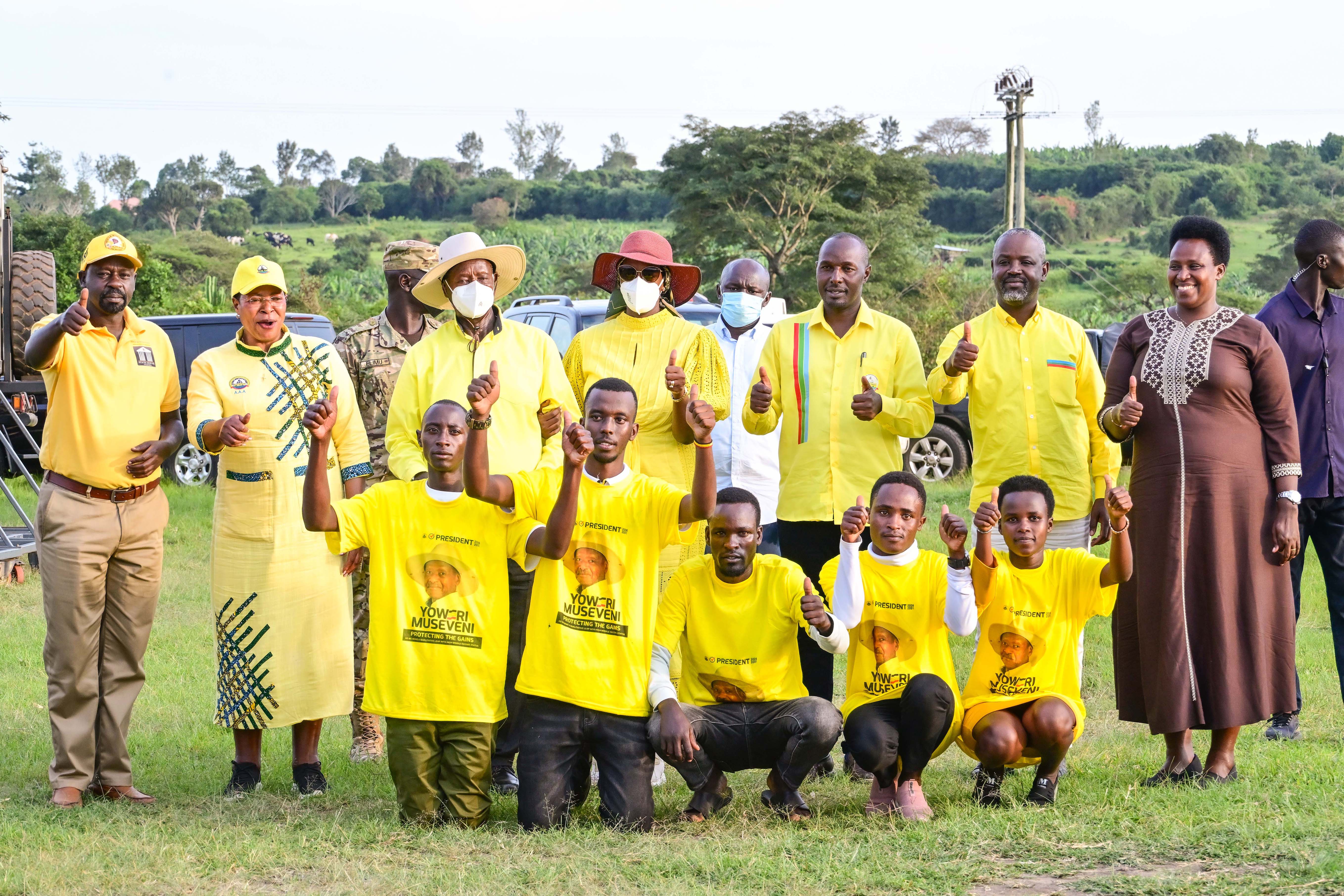
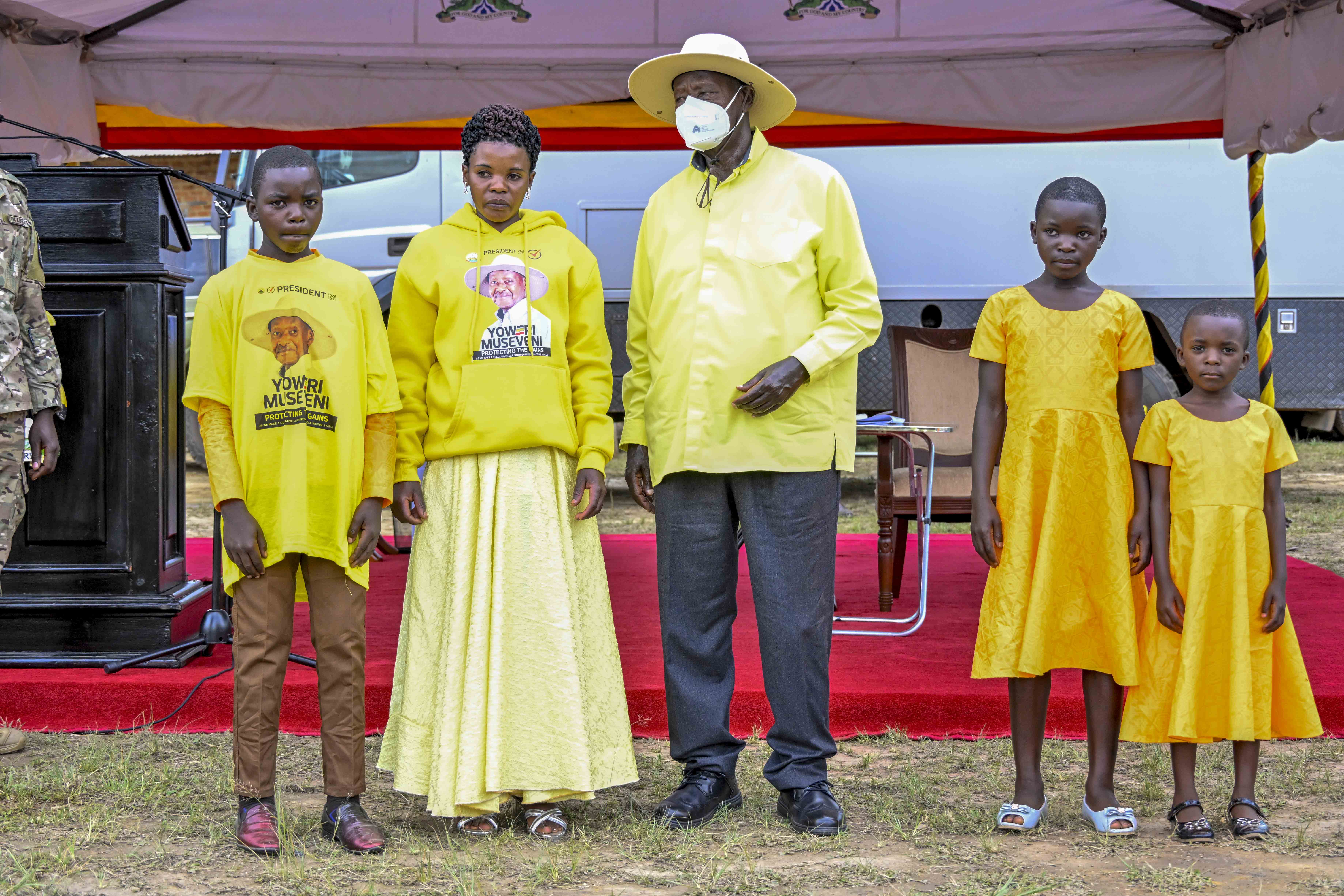
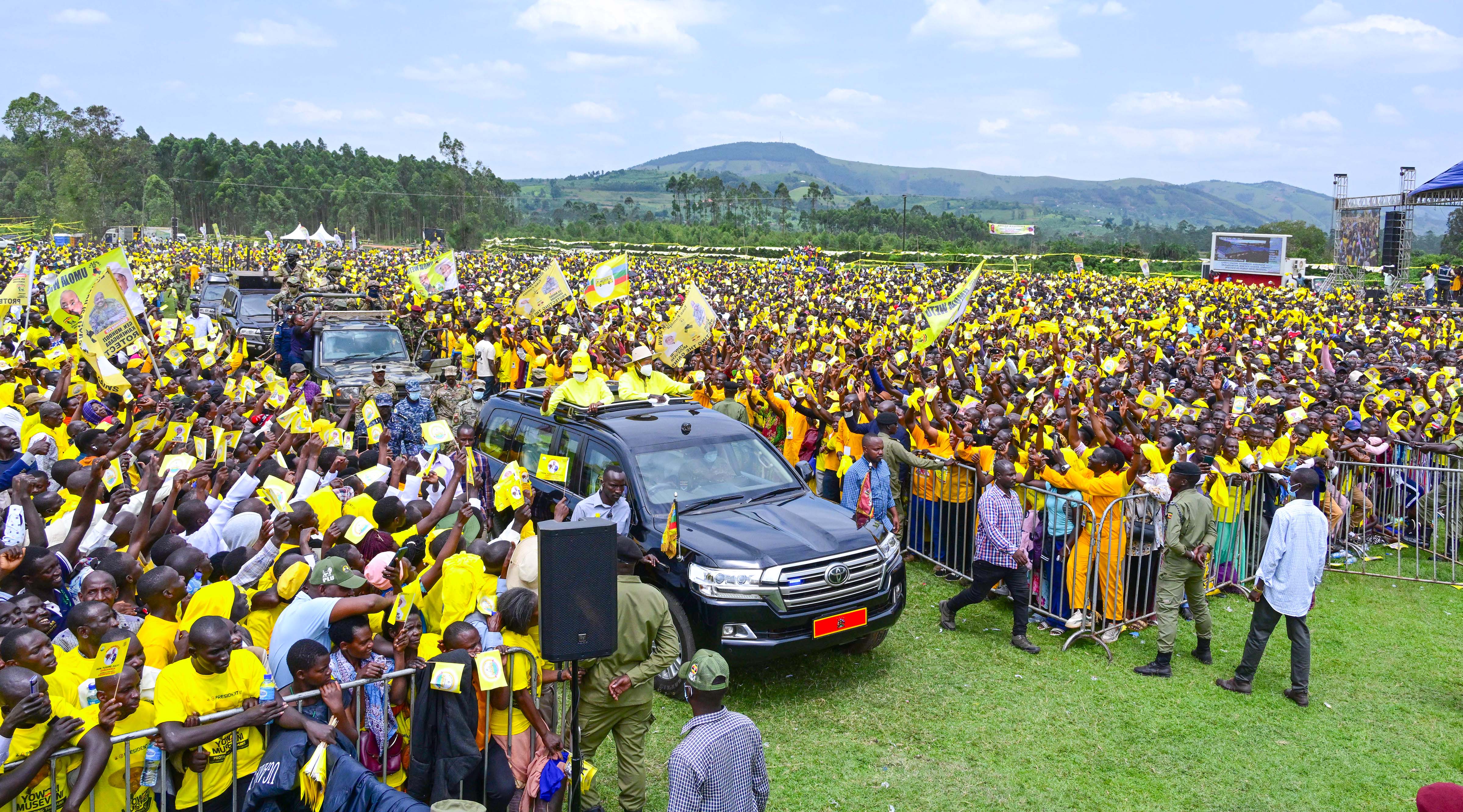
President Yoweri Kaguta Museveni has directed Parish Development Model (PDM) officials across the country to stop denying youth access to PDM funds over claims that they lack land, insisting that the viability of youth projects, not land ownership, should be the basis for approval. The President who was accompanied by the First Lady and Minister of Education and Sports, Maama Janet Kataaha Museveni, issued the directive on Monday, December 1, 2025, while addressing thousands of supporters at Bujaga Playground in Rwampara District during a campaign rally ahead of 2026 general elections. The President expressed strong dissatisfaction with reports that youth in several parishes have been turned away from accessing the PDM revolving fund because they do not own land—an issue he described as “misguided and unacceptable.” “For the youths, I have heard reports that elders are not allowing them to access PDM at the parish because they don’t have land,” President Museveni said. “Stop that. Get their projects and review them and leave them to invest in whatever they want. They can rent land to invest in anything they wish.” He emphasized that PDM was designed to give all Ugandans, especially the vulnerable ones still in the subsistence economy, a fair chance to enter income-generating activities. Land ownership, he said, is not a prerequisite for innovation or entrepreneurship. He cited examples of youth who have used the funds creatively, including Ayesigwa Kenneth, a young man from Nyamirama in Kanungu District who used his PDM allocation of Shs1 million to hire space for a small restaurant, later expanding into piggery—demonstrating innovation through minimal resources. “These excuses of saying someone has no land and therefore should not get money—I don’t want to hear this,” President Museveni insisted. “Look at the viability of their project before denying them money.” Under the PDM framework, 30% of the parish revolving fund is ring-fenced for youth aged 18–30 to support their participation in income-generating ventures. President Museveni reminded Rwampara residents that the NRM government has always combined guidance with practical support. “NRM doesn’t only advise and show you what to do, but also supports you to start,” he said. “Use this PDM money well and you will be prosperous.” He revealed that the government plans to supplement PDM funds with free coffee seedlings for households ready to embrace commercial agriculture. “I have already informed the relevant departments to get coffee seedlings and give them for free to those who need them,” he added. President Museveni, who is also the NRM presidential flag bearer, used the rally to reinforce the central focus of his re-election message—peace, development, wealth creation, and job creation—while unveiling highlights of the NRM’s 2026–2031 manifesto. The President reminisced about his earlier years in Rwampara, describing the area as a place filled with personal and historical significance. He recalled that he first passed through Bujaga 68 years ago in 1957, walking from Kyamate to play football. He also noted that he traversed the area during the liberation struggles of 1979 and 1985. “It feels good to be back here and seeing you in good health,” the President told the cheering crowd. President Museveni used the rally to reintroduce key pillars of the NRM’s five-year manifesto, focusing on four of the seven commitments: peace, development, wealth creation, and job creation. He said Uganda’s enduring peace is one of the NRM’s greatest achievements. “We were in wars twice, in 1979 and 1985. What caused those wars was the politics of identity—tribe, religion—making it difficult to run the country,” he said, arguing that by uniting Ugandans and building a national army not based on sectarian lines, the NRM restored stability, enabling economic growth. “I want you to support this peace to continue,” he appealed. President Museveni highlighted major infrastructure improvements in Rwampara, praising the district for the progress made under NRM. He noted that the main road through Rwampara was tarmacked in 1963 and has since been repaired several times by the government, opening many connecting routes across the district. “We shall upgrade Buteraniro– Bugamba–Rwoho–Bukoni–Kitwe road and Ruti–Mwizi–Kikagate road,” he announced. These, he said, will boost trade, ease mobility, and reduce transport costs. President Museveni also addressed the issue of water for irrigation, noting that Rwampara is blessed with abundant water sources but is underutilizing them. He referenced the government banana plantation in Nyaruzinga, Bushenyi, run by Prof. Florence Muranga, where irrigation from a swamp supports yields of up to 53 tons of bananas per acre—ten times the average yield in surrounding areas. On health, President Museveni applauded Rwampara’s improvement in health services, noting that the district’s eight Sub-counties now host 2 Health Centre IVs and 6 Health Centre IIIs. “All eight sub-counties have a health facility. In the 1990s, the whole of Rwampara County had only three drug dispensaries. This is great progress,” H.E. Museveni said. He committed to delivering a district hospital in the next term, responding to local leaders’ appeals for a major health facility at Bugamba to serve hard-to-reach areas. On education, Rwampara District currently has 74 government-aided primary schools with 35,148 pupils and 7 government-aided secondary schools with 3,954 students, 20 of the 29 parishes host at least one government primary school, while nine parishes still lack one. President Museveni compared the current progress to the limited secondary school options available in the 1950s, saying: “In 1953, we had only Kisubi, Buddo, and Ntare for A-Level studies. Today, Rwampara alone has seven secondary schools. I feel happy.” President Museveni stressed that while development is a public good provided by the government, wealth creation remains a personal effort—rooted in commercial production. He highlighted several examples of successful farmers and entrepreneurs who used small resources to build large enterprises, including George Matongo of Ngoma in Nakaseke district, who now sells 900 litres of milk per day, earning Shs 21 million per month, despite being 70 miles from the nearest tarmac road. Johnson Basangwa, a major poultry farmer from Kamuli, who earns an estimated Shs20 million per day from egg sales and employs more than 300 workers, was highlighted as another success story. Similarly, Korea Dick Ogira from Abim District received 200 mango seedlings from Operation Wealth Creation and Shs880,000 under the Parish Development Model (PDM). He planted two acres of cassava and now earns about Shs6 million from each harvest—conducted twice a year—totaling Shs 12 million annually. With the growing market provided by the Soroti Fruit Factory, his annual income is projected to rise to Shs36 million. “These people have no tarmac roads, but they are rich,” President Museveni said, urging residents of Rwampara to draw inspiration from such examples and replicate their success. Job Creation: The President reiterated that Uganda’s sustainable jobs come from four sectors: Commercial agriculture, Manufacturing, Services, and ICT, warning that government jobs remain limited. “The government has only about 480,000 jobs, yet factories employ about 1.2 million people,” he said. President Museveni showcased the Sino-Mbale Industrial Park, describing it as “a town of 75 factories,” and a key contributor to employment and economic diversification. In her remarks, Maama Janet thanked the people of Rwampara for turning up in large numbers and emphasized the value of the peace Uganda enjoys. “Countries with no peace have their people seeking refuge in Uganda,” she said. “Their only hope is in Uganda because of its peace from border to border.” She encouraged residents not to assume the election was already won, urging them to turn out and vote in large numbers on polling day. Rwampara District NRM Chairperson, Mr. Gordon Mutima welcomed the President and thanked him for elevating Rwampara from a county to a district in 2019, with headquarters in Kinoni Town. He reiterated the district’s request for a district hospital at Bugamba to improve service delivery in the underserved sub-counties. The rally was attended by ministers, Members of Parliament, NRM leaders, and party flag bearers.

img
01 December 2025
PRESIDENT MUSEVENI RALLIES MBARARA TO VOTE FOR NRM FLAGBEARERS IN 2026 GENERAL ELECTIONS

President Yoweri Kaguta Museveni, accompanied by First Lady and Minister of Education and Sports, Maama Janet Museveni, was this afternoon received by thousands of supporters at Booma Grounds in Mbarara City as he continued his campaign trail in Ankole Sub-region. At the rally, the President addressed residents from both Mbarara district and city where he rallied them to vote for the National Resistance Movement (NRM) flagbearers in the 2026 general elections. President Museveni also highlighted the first NRM contribution to Uganda—peace, recalling the turmoil the country faced in 1972, 1979 and 1985. He said today the country enjoys peace “from border to border” because the NRM rejected sectarian politics based on religion, tribe, gender and other divisions, enabling the establishment of strong institutions such as the police, army and judiciary. The second contribution—development, he said, comprises economic and social infrastructure. President Museveni pointed to improvements in the national road network under the NRM government, including the rehabilitation of old roads, and announced that the government will construct the Biharwe– Bwizibwera road. He added that electricity coverage has significantly expanded and “is almost everywhere.” On wealth creation, the President urged Ugandans to shift attention from development alone to improving household income. He cited the example of George Matongo of Ngoma, who earns Shs21 million per month from dairy farming despite living far from tarmac and electricity. President Museveni encouraged families with small landholdings to adopt the four-acre model: coffee in the first acre, fruits in the second, pasture for zero-grazing dairy cows in the third, food crops in the fourth, and enterprises such as poultry, piggery or fish farming in the backyard. He said the NRM government is the only one in Africa that gives citizens money to help them overcome poverty, arguing that infrastructure alone is not useful if citizens remain poor. For urban residents, he highlighted skilling centres that offer training in hairdressing, tailoring, welding, brickmaking, bakery and more—skills that can create wealth even for those without land. President Museveni added that 30% of Uganda’s population remains outside the money economy, and this is the group he is determined to integrate. He listed job creation as the fourth NRM contribution, noting that jobs come from commercial agriculture, services, ICT and factories. The President appealed to the people of Mbarara to continue supporting the NRM, saying the party has already demonstrated its contributions to Uganda. On her part, Maama Janet praised the unity and overwhelming support to NRM by the people of Mbarara. “Today the people of Mbarara have spoken to the whole of Uganda without saying anything. You have made a big statement. I want to request you to continue doing grassroots mobilisation house to house and aim at getting 99.9% in Mbarara in the coming election for the NRM. Most people say that when you come in big numbers like this, it means that it’s an automatic win for NRM, but you need to go an extra mile—look for more votes and encourage them to come on the voting day and vote for the NRM,” she said. Mbarara District NRM Chairperson, Mr. Atuheise Prosper hailed the President for founding a party that has united Ugandans and rejected sectarianism based on tribe, religion or political affiliation. He also thanked the President for the development programmes in the district, including the Parish Development Model and improved road networks. Mbarara City NRM Chairperson, Mr. Wilson Tumwine thanked the President for approving the upgrade of Nyakisharara Airfield into an international airport. He also requested the construction of a stadium in Mbarara City to boost sports development and nurture local talent.

img
29 November 2025
“BUHWEJU’S LONG- AWAITED ROAD SET FOR CONSTRUCTION,” PRESIDENT MUSEVENI REVEALS

President Yoweri Kaguta Museveni, also the National Resistance Movement (NRM) Presidential flag bearer for 2026 general elections, today held his first campaign rally of the day in Buhweju District. Addressing thousands of his supporters at Engaju Secondary School in Buhweju, the President announced that the long-awaited Bwizibwera– Nyakambu– Nsiika–Nyakashaka–Nyakabirizi road is going to be constructed. “We have not worked on this road, but now the China Railway 18th Bureau Group is ready. They are securing Shs 30bn to compensate those affected along the road, after which construction will start immediately,” he said. President Museveni emphasized the value of peace in Buhweju, noting that the district borders Kasese, which has experienced insecurity linked to conflicts in neighboring Congo. “I once passed through Buhweju by car and found the people well-rested and enjoying their evening. That’s peace,” he said. “Uganda was never easy to manage in terms of peace. So, when opposition leaders come asking, can you manage peace, I say, Buhweju knows what NRM has done,” he added. Recalling a recent meeting with local leaders, he narrated a story about a man named Ngoma Elanze, born in Congo in 1964 when Patrice Lumumba was killed and the country was in turmoil. “At one time, Uganda was once also ‘Ngoma Elanze’, but NRM restored peace,” he said. The President noted that out of 348 villages in Buhweju, 261 now have safe water, meaning 75% of the district enjoys access to clean water. On health, he highlighted that in 1980, Buhweju’s population was 34,000, growing to 167,000 today. “This growth shows the success of our immunization program. All these children are NRM children,” he said. President Museveni also outlined plans to expand healthcare in the district; upgrade Nsiika HCIV to a General Hospital, upgrade Engaju HCIII to HCIV and construct new HCIIIs in Kashenyi-Kajani, Nyakaziba, Rubengye, and Rwengwe sub-counties. Ongoing works include upgrading Bitsya HCII to HCIII, staff house construction at Kiyanja HCIII, and renovations at Karungu and Burere HCIIIs. Education in Buhweju has also grown, with 56 government primary schools and 130 private primary schools, reflecting the community’s ability to invest in education. He mentioned that the district has seven government secondary schools, with more under construction. “All 140 sub-counties will eventually have government secondary schools,” President Museveni said. The President also highlighted the story of Ms. Mary Getrude Kyomugasho from Nyakashaka Town Council, a primary seven school dropout. With support from a government skilling program, she trained in tailoring and knitting, developed her skills, and started her own workshop. “Today I have three machines and two employees. I pay them Shs 5,000 per day, and I continue growing my business. Thank you, President Museveni, for changing my life,” she said. President Museveni praised Kyomugasho, saying, “She has got a skill and capital, and that is what creates jobs.” The President emphasized that while Uganda has made enormous strides in development, household wealth must now be the focus. He clarified the long-standing confusion between development and wealth creation, noting that urban centres enjoy vast infrastructure, yet some residents remain poor. He outlined the four pillars of wealth creation including; commercial agriculture, manufacturing and factories, services such as hotels and transport and ICT. President Museveni reminded the supporters that after securing peace, the NRM introduced the Four-Acre Model in the 1996 Manifesto as a practical pathway out of poverty. He explained the model; one acre for coffee, one acre for fruits, one acre for pasture for dairy cattle, one acre for food for the family and then backyard poultry or piggery, and fish farming for communities near wetlands. The President also handed over the NRM flags to aspiring Members of Parliament, LC V chairperson, councillors, and other party candidates in Buhweju District, formally endorsing their participation in the upcoming elections. Rt. Hon. Anitah Among, Speaker of Parliament and NRM’s Second National Vice Chairperson (Female), praised the President, saying: “We welcome you, Your Excellency, to Buhweju. Thank you for coming to campaign in our district. We appreciate your leadership and the work you continue to do for our communities.” Rt. Hon. Among specifically commended the President for including the Bwizibwera–Nsiika–Nyakashaka–Nyakabirizi road in the National Development Plan IV (NDP IV). “The road is in dire need of repair, and the people of Buhweju are grateful knowing that work will commence soon,” she said. She further thanked the government for the Buhweju Tea Factory, noting that Shs 310 billion has been provided to support tea farmers and processors. She urged the farmers to continue improving production. Eng. Jonard Asiimwe, the Vice Chairman-NRM Western Uganda, welcomed the President and assured him of strong mobilization efforts in the district. He highlighted achievements in coffee production, tourism, and mining, noting the need for improvements in the mining sector. The Buhweju NRM Chairperson, Mr. Godfrey Kabandize, presented a Memorandum of Understanding that shared detailed insights on the district’s demographics and development progress. He noted that Buhweju has 14 Sub-Counties/Town Councils, 68 Parishes, and 348 villages, with a population of 167,921. In 2025, the district had 77,082 registered voters, an increase of 10,433 since 2021, and now operates 223 polling stations, up from 182. Mr. Kabandize also highlighted the Parish Development Model (PDM), noting that out of 35,305 households, 21,762 households (61.6%) have already benefited from PDM funds totaling Shs 20.8bn. “The remaining 13,543 households (38.4%) are still to benefit, including those already engaged in the money economy,” he said. The district has also made strides through Emyooga SACCOs, which now include 36 SACCOs with 10,020 members, receiving a total of Shs 1.46bn from the government to support small-scale business and entrepreneurship. Buhweju has 56 government primary schools and 103 private schools, yet 29 of 68 parishes still lack access to a government primary school. On the secondary education front, the district has 7 government and 17 private secondary schools, enrolling 2,506 students. All government schools provide Universal Secondary Education (USE) and Universal Post-Ordinary Level Education and Training (UPOLET). Three Seed Secondary Schools are currently under construction, which will reduce the number of sub-counties without a government secondary school from 7 to 4, a move hailed as critical for improving access to quality education across the district. In healthcare, only one HCIV and nine HCIII facilities currently serve the district, leaving four sub-counties without a health facility. Planned upgrades include Nsiika HCIV to a General Hospital, Engaju HCIII to HCIV, and the construction of new HCIIIs in Kashenyi-Kajani, Nyakaziba, Rubengye, and Rwengwe sub-counties. Ongoing projects such as the upgrade of Bitsya HCII to HCIII and renovations in Karungu and Burere health centers are expected to improve service delivery. Access to safe water has improved significantly, with 261 out of 348 villages (75%) now served. The government has completed multiple interventions, including protected springs, gravity flow schemes, and rainwater harvesting tanks. Piped water systems in Nsiika, Rwamwanja, Kajani-Kasheni, Rutehe, Kayonza, and Kyamuhunga now serve thousands of residents. Efforts in water for production have also begun to pay dividends. Small-scale irrigation schemes in Kyisa (5 acres producing 5.5 tons of tea) and Kyesika (12 acres producing 2.5 tons of tea) now generate Shs 9.9 million and Shs 7 million annually, respectively, benefiting local farmers and demonstrating the potential of irrigation to boost livelihoods. Meanwhile, Buhweju District is now fully connected to the National Electricity Grid, opening new opportunities for businesses, households, and public services. Mr. Kabandize concluded by reaffirming Buhweju’s support for the President. “Through NRM structures, the people of Buhweju are ready to support you 100%. We are committed to ensuring that every development initiative succeeds in our district,” he said. The event was attended by NRM Central Executive Committee (CEC) members, Members of Parliament, religious and cultural leaders, as well as thousands of supporters.

img
29 November 2025
PRESIDENT MUSEVENI PLEDGES COFFEE PROCESSING FACILITY FOR IBANDA, HIGHLIGHTS NRM ACHIEVEMENTS

President Yoweri Kaguta Museveni, the National Chairman of the National Resistance Movement (NRM) and the party’s flag-bearer for the 2026 elections, has pledged to support coffee farmers in Ibanda District by establishing a coffee processing facility aimed at boosting productivity, improving quality, and raising household incomes through value addition. President Museveni made the commitment on Saturday, 29th November 2025, while addressing thousands of supporters during a campaign rally at Kagongo Demonstration School playground in Ibanda District, as he intensified his campaign trail across the Ankole sub-region. Ibanda, one of Uganda’s significant coffee-producing districts, grows both Arabica and Robusta varieties, with Arabica thriving particularly well in areas that lie within the high-altitude ranges of the Rwenzori Mountain ecosystem. Coffee farming remains one of the backbone economic activities for the district’s households, making the President’s pledge a major development prospect for the region. “You, the people of Ibanda, already know what to do. Therefore, I will help you establish a coffee processing facility that you have proposed here to add value to your coffee,” President Museveni told the cheering crowd. He added that the government would continue supporting farmers under the Parish Development Model (PDM), including providing free coffee seedlings from both government nursery beds and his personal nurseries at Kisozi. “We shall continue with the PDM money and also give you free coffee seedlings from the government nursery beds that we shall establish,” President Museveni said. “PDM will continue where people invest in whatever they want—poultry, pigs, goats, and others.” The NRM Chairperson for Ibanda District, Hon. Jovrine Kaliisa Kyomukama, highlighted the district’s impressive coffee footprint. She noted that the district has 28,062 acres under coffee cultivation, producing an estimated 14,381 tons annually and earning up to Shs 178 billion in revenue. Despite these gains, Hon. Kyomukama said farmers still face challenges, particularly the shortage of modern coffee dryers, hullers, and processing equipment at the parish level, making value addition difficult. “The coffee you gave us through PDM has done wonders, leading to improved coffee production at the household level,” she told the President. “But we need dryers per parish and coffee hullers.” Residents at the rally shared testimonies reflecting the district’s growing prosperity from commercial agriculture. Mr. Mutabaazi Wilbroad, a coffee farmer from Nyabuhikye Sub-county, revealed that he earns more than Shs 40 million per season from his 8-acre coffee farm. “From one acre, I get about Shs 8 million per season, meaning Shs 16 million per year,” he said. President Museveni praised such success stories, saying coffee has transformed the livelihoods of many households across Uganda. He noted that Uganda now earns US$2 billion annually from coffee exports, making it one of the country’s biggest sources of foreign exchange. “Coffee has created wealth for households and for the country as well,” he emphasized. According to official statistics presented at the rally, Ibanda District has shown strong progress in PDM implementation. Ibanda District (40 PDM SACCOs) received Shs 14.39 billion, of which Shs 12.39 billion (86.07%) was disbursed to 12,391 households, while Ibanda Municipality (21 PDM SACCOs) received Shs 7.50 billion, of which Shs 6.45 billion (85.96%) was disbursed to 6,454 households. In total, Ibanda District and Municipality have received Shs 21.9 billion. President Museveni encouraged parish and sub-county leaders to ensure the remaining households also benefited. He, however, cautioned the public against confusing development with wealth creation. “Development is for all of us - schools, roads, hospitals. But wealth and poverty are personal. We need households to embrace wealth creation,” he said, revisiting the 4-acre model that the government introduced in the 1996 manifesto. Under the model, farmers are encouraged to allocate one acre to coffee, one to fruits, one to food crops, and one to zero-grazing livestock, while using backyards for poultry, piggery, or fish farming. President Museveni used the Ibanda rally to highlight the seven key contributions of the NRM as featured in the 2026–2031 manifesto. He reminded voters of the importance of peace in the region, noting that threats from armed groups that previously operated in the Kamwenge forests had been neutralized. “You, the people of Ibanda, know what peace means,” he said. “Those who wanted to disrupt this peace were dealt with.” On development, President Museveni emphasized ongoing and upcoming infrastructure projects, including major road works across the region. He assured residents that the Mbarara–Ibanda road would be repaired afresh, while other routes—including Ishaka–Bushenyi, Ibanda–Kagongo–Kabujogera–Kamwenge, and Nyamarebe–Kyegegwa—would also be fully rehabilitated. He further promised to consider establishing a ferry on Lake George to boost trade between Rubanda, Rubirizi, and Kasese districts. According to Hon. Kyomukama, the absence of a reliable transport system across the lake currently forces residents to use risky alternatives, especially when transporting livestock to markets. On the side of social infrastructure, the President acknowledged that Ibanda performs well in accessibility to government schools and health facilities, but advised residents to prioritize wealth creation alongside development, saying it's through wealth that jobs are created. President Museveni pointed to the growing number of industrial parks—such as Sino-Mbale Industrial Park with 75 factories and Namanve Industrial Park with over 270 factories—as evidence of the NRM’s commitment to job creation. “These employ far more Ugandans than government institutions, which have only 480,000 jobs for a population nearing 50 million,” he said. To illustrate opportunities in commercial agriculture, President Museveni cited success stories such as Johnson Basangwa, a poultry farmer in Kamuli who produces 200 trays of eggs daily and earns Shs 20 million per day, employing 300 workers. Another example was of Mr. George Matongo, a dairy farmer from Ngoma, Nakaseke, who produces over 900 litres of milk daily, earning about Shs 21 million per month, despite living far from tarmac roads or electricity. Ibanda has historically been an NRM stronghold, and in the 2021 Presidential Elections, out of 140,486 registered voters, 90,801 (64.6%) turned up, with President Museveni winning 77,521 votes (87.3%). For the 2026 elections, Ibanda has 153,810 registered voters, an increase of 13,324. Polling stations have grown from 280 in 2021 to 410. Saturday’s rally attracted prominent NRM leaders, including Speaker of Parliament and party's Second National Vice Chairperson, Rt. Hon. Anita Annet Among, NRM Vice Chairperson for Western Uganda, Eng. Asiimwe Jonard, district leaders, and other senior party officials.

img
28 November 2025
PRESIDENT MUSEVENI RECEIVES HEROIC WELCOME IN KAZO, UNVEILS NRM’S 40-YEAR ACHIEVEMENTS AND NEW COMMITMENTS FOR THE DISTRICT

President Yoweri Kaguta Museveni today received a heroic welcome in Kazo district where thousands of jubilant supporters gathered as he continued his campaign trail across the Ankole Sub-region. Accompanied by the First Daughter, Mrs. Patience Rwabwogo Museveni, the President addressed the rally with a detailed breakdown of the NRM’s achievements over the past 40 years and the commitments contained in the 2026–2031 NRM Manifesto. President Museveni told the supporters that the NRM’s first and most important contribution to Uganda is peace, which he said was achieved by rejecting sectarian politics based on religion and tribe. “Because we rejected sectarianism, we were able to build a national political party, a national army, a national police force and ensure stability across the country,” he said. On development, the President outlined progress in both economic and social infrastructure. He cited Kazo’s major tarmac road, part of the Lyantonde–Fort Portal corridor, as a key achievement under the NRM government. President Museveni pledged to extend water to Kazo the same way the government connected Kiruhura through Kakyeera and obtained water from the Kagera River for Mbarara. “We shall get water for Kazo from the Katonga River,” he assured residents. President Museveni also praised progress in the education sector, noting that Kazo now has 63 government primary schools and 254 private primary schools, compared to the years before NRM when many of these schools did not exist. The district also has six government secondary schools and 32 private secondary schools, serving a combined total of more than 36,000 learners. He said this transformation is a result of deliberate NRM investment in social infrastructure, which must be protected and expanded. Turning to the health sector, President Museveni noted that Kazo has one Health Centre IV, seven Health Centre IIIs and 11 Health Centre IIs, but urged residents to appreciate the progress made from the era when health facilities were scarce. He reaffirmed government plans to upgrade Kazo Health Centre IV into a District Hospital, along with upgrading Rwamuranga and Migina Health Centre IIs. Ongoing projects such as the construction of medical stores and a mortuary at Kazo HCIV, funded by the World Bank, were highlighted as timely additions for improving service delivery. The President then spoke on the NRM’s third pillar—wealth creation—and why households must differentiate it from development. He reminded residents that development benefits everyone, but wealth belongs to each family. President Museveni reiterated the Four-Acre Model and criticised the continued practice of free-range grazing in Ankole. “When you do free grazing, one square mile can graze only 200 cows. But when you plant pasture, one acre can feed eight cows, meaning a square mile can handle 500 cows,” he explained, thus encouraging zero-grazing and warned against the habit of selling large ancestral lands and later buying more unproductive land elsewhere. President Museveni further hailed the transformation of Uganda’s dairy and coffee sectors, attributing success to Operation Wealth Creation under Gen. Salim Saleh and to farmers who embraced commercial agriculture. He said the NRM’s fourth contribution—job creation—has flourished through commercial agriculture, manufacturing, services and ICT, noting that factories already employ 1.3 million people, far more than the 480,000 employed in government institutions. He also cited the impact of skilling hubs that support youths who dropped out of school but have since gained practical skills and created employment for themselves and others. The Speaker of Parliament and Second National Vice Chairperson (Female), Rt. Hon. Anita Among praised the President for the development he has brought to Kazo, including improved roads, expansion of the technical institute in the area, and strengthened public services. Western Region NRM Vice Chairperson, Hon. Jonard Asiimwe, told the rally that all the concerns raised by Kazo residents had been captured by the party and would be addressed. He encouraged the district to continue supporting the NRM as the only party with a clear and consistent development agenda. Kazo District NRM Chairperson, Mr. Nkeija Wilson, thanked the President for elevating Kazo to district status and said government services had become more accessible as a result. He saluted the President for developments in education, health, electricity and other sectors, pledging that Kazo would vote President Museveni “100 percent” in the upcoming elections. Former Kazo County MP, Hon. John Nasasira, also paid tribute to the President for his contribution to national liberation and development, noting that administrative elevation and improved service delivery have greatly benefitted the people of Kazo. He also credited the NRM’s household-income approach for empowering families and reducing poverty levels.

img
28 November 2025
PRESIDENT MUSEVENI RALLIES KIRUHURA AND KAZO TO EMBRACE PROFITABLE DAIRY FARMING

President Yoweri Kaguta Museveni has urged residents of Kiruhura and Kazo districts to fully exploit their vast land for commercial dairy farming, saying the cattle corridor has the potential to become Uganda’s largest hub of milk-based wealth creation if farmers abandon free-range grazing and adopt intensive production systems. Addressing thousands of supporters at Nyakasharara playground in Kiruhura District on Friday, 28th November 2025, President Museveni, accompanied by the First Daughter, Pastor Patience Rwabwogo, praised the community for gradually shifting from nomadic livestock rearing to commercial dairy farming but insisted that greater transformation is still possible. “The people of Kiruhura and Kazo, and the entire cattle corridor, thank you for heeding our advice on working and grazing cows for wealth creation. But do not stop,” he said. “Free-range grazing makes the land underutilized. On one square mile, you are managing only about 130 cows. But if you adopt zero grazing, you can keep thousands of cows on the same land,” the President emphasized, adding that wealth creation, not mere ownership of land or livestock, is central to Uganda’s household prosperity agenda. President Museveni illustrated his message with success stories of farmers who have built thriving enterprises on small pieces of land by adopting modern practices. One such farmer is Joseph Ijala, a former taxi driver who now runs an integrated farm on 2.5 acres. Ijala started with poultry and expanded into dairy farming. He keeps 10,000-layer chickens, producing 310 trays of eggs per day and earning more than Shs 3 million daily. On just 1.5 acres of land, Ijala also practices zero-grazing dairy farming with eight cows, producing a substantial amount of milk daily. Combined, he earns about Shs 6.8 million per month from eggs and milk. President Museveni said Ijala’s example demonstrates how zero grazing drastically increases productivity. “Ijala keeps eight cows on one acre. If that were a square mile, he would keep over 4,000 cows,” he said. Another example is Richard Nyakaana, a farmer in Kabarole whose Kana Farm sits on only 1.2 acres. Nyakaana runs a range of enterprises, including layer poultry, zero grazing, feed processing, and manure production. With only six milking cows, he produces 120 litres of milk per day, earning Shs 110,000 daily, amounting to Shs 20 million annually in profit. “You people in the cattle corridor have a lot of land. Use that land profitably,” President Museveni urged. “The third contribution of the NRM is wealth creation. Development benefits everyone, but wealth and poverty are yours as a household.” President Museveni also cited George Matongo, a dairy farmer from Ngoma in Nakaseke, as a symbol of the transformative power of commercial agriculture. Matongo, who reportedly never attained formal education and lives far from infrastructure such as tarmac roads or electricity, produces over 900 litres of milk per day and earns an estimated Shs 21 million monthly. “Matongo is extremely prosperous, yet he lives far from a tarmac road or electricity,” H.E. Museveni said. “Meanwhile, people are living next to smooth tarmac roads, but poverty is the order of the day.” The President said Matongo’s success underscores his long-held message that wealth is created by individuals, not by the government, and that the presence of roads or electricity alone cannot guarantee household income. “When I came to Rwakitura many years ago, I followed the grass and invested in farming. People laughed at me. But by the time the tarmac road and electricity arrived, I was already rich,” he said. President Museveni reminded the gathering that upon taking power in the mid-1980s, the new government prioritized mobilizing citizens to embrace the money economy. “In the 1996 manifesto, we introduced the four-acre model,” he said. “We told people: one acre for coffee, one for fruits, one for family food crops, and one for zero grazing. Then use the backyard for poultry, piggery, or fish farming.” Kiruhura District is one of Uganda’s leading milk producers, supported by cattle-keeping communities and emerging processing facilities. The President urged farmers to push for even higher productivity. “Learn to plant grass for zero grazing and avoid free-range grazing. You have the land; use it,” he said. He hailed farmers who embraced this model early on, including those in Nyabushozi, Kiruhura, and Ssembabule. But he also cited examples from other regions, such as Joseph Basangwa of Kamuli, a commercial poultry farmer producing about 200 trays of eggs daily and earning an estimated Shs 20 million per day—translating into billions annually. Basangwa employs more than 300 workers. “People say jobs-jobs-jobs - but where do jobs come from? Agriculture, factories, services, and ICT—not the government,” President Museveni noted. He stressed that while the government continues to deliver security and development, families must take responsibility for creating wealth within their households. “Development is for all of us, but wealth is yours as a family,” he repeated. He highlighted the massive growth of industrial parks, including the Sino-Mbale Industrial Park with over 75 factories, and the Namanve Industrial Park with over 270 factories. These, he said, employ far more Ugandans than government institutions, which have only 480,000 jobs for a population nearing 50 million. While reviewing social services, President Museveni noted that the district has 74 government primary schools and 165 private primary schools. For secondary education, Kiruhura has 7 government secondary schools and 11 private secondary schools. He said the proliferation of private schools in Kiruhura reflects improved household incomes in the region. “It shows wealth among the people, because they can afford school fees in private schools,” he noted. On health services, President Museveni observed that Kiruhura’s 14 sub-counties have one Health Centre IV and 13 Health Centre IIIs. However, Akayanja Sub-County currently has no health facility. The President assured the residents that the government plans to construct a new HCIII there. He also pledged to improve the road network connecting districts in the greater Ankole region. Earlier, Speaker of Parliament and NRM Second National Vice Chairperson, Rt Hon. Anita Annet Among welcomed President Museveni to Kiruhura and thanked residents for supporting the ruling party. “We want to thank you, the people of Kiruhura, for bringing up a son—President Museveni—who has taken Uganda from despair to hope,” she said. “Your son has brought peace to Uganda. The Bible says: ‘We shall know them by their deeds,’ and we have seen President Museveni’s deeds.” Speaker Among credited the President for introducing free education, saying it enabled many Ugandans, including herself, to rise to positions of responsibility. “All we can do is continue praying for you and thanking you for respecting the people of Kiruhura by coming to ask them for their vote,” she said. The event was attended by several NRM leaders, ministers, Members of Parliament, and party flag bearers.

Latest Press Releases

Opinion Posts

author's photo
30 November 2025
2026 GENERAL ELECTIONS: GUARDING THE VOTES MIGHT BE TRICKY ON VOTING DAY

As the country prepares to go for the general elections, come January 15, 2026 some political actors are urging their supporters to come out in big numbers and cast their vote and at the same time guard the votes, by not leaving the polling stations when they have finished casting their votes. Urging people to turn up and vote for their preferred candidates is in itself a fantastic idea, but telling them not to leave the polling stations, on the pretext of guarding the votes, is tricky and might be dangerous to the voters, as it probably could disrupt the very voting and counting processes they intend to protect. Organizing popular elections is indisputably a challenging task. Bodies in charge of administering elections have the demanding function of ensuring that many complex election and related processes are managed efficiently, impartially and transparently. This is because the whole process has a direct impact on the quality and integrity of electoral processes and is one of the keys to ensuring the rights of voters and contestants. Having a flawless voting process is, therefore, the main guardian of democratic elections, and their activities are central to fostering public confidence. However, for a country to deliver such a clean election to the satisfaction of the voters and the candidates, it must facilitate and equip the Electoral Commission (EC) with all the required logistical support it requires, to deliver a seamless believable exercise. As required by law, the EC will gazette the polling guidelines to Ugandans a few days before the polling date. These guidelines are meant to educate our people about the entire voting process and how they should conduct themselves during the voting period. Such guidelines are not made in their boardrooms only, they look and compare other best practices, across other democratic nations around the world and then design those that suit our system. The EC has been financed and facilitated to benchmark the rest of the world, on how to deliver a smooth, flawless and impartial election. Therefore, it is very unfair for one to create mistrust about EC’s competence to deliver uncontested results. Consequently, all participants in the voting processes will be required to observe EC guidelines. It is perilous for one to ignore these guidelines and these are the reasons. Firstly, telling people not to leave the polling stations after voting means that you are publicly declaring that you do not trust the EC and, therefore, the voters are now going to manage the voting process! This is dangerous. You cannot have people, who have been emotionally charged during the campaign season, gathering in their thousands at polling stations and you expect them to remain cool, calm and collected when the presiding officer begins announcing the winning candidates, to the detriment of the losers. What will you do if a nasty fight breaks out? Won’t the one police officer deployed, at the polling station, be overwhelmed? And what might follow? Probably death and grievous bodily injuries. For the purposes of guarding against any form of mischief, at any polling station, the EC deploys 8 polling officials at every polling station and each candidate (whether they are presidential or parliamentary) are allowed to deploy 2 polling agents to closely observe the whole process from material delivery, voting, vote counting and announcement. On top of these are journalists and observer groups, as long as they are accredited by the Electoral Commission, to witness the entire exercise. Secondly, I do not think the EC has the capacity to provide sanitary requirements for hundreds of people gathering in over 30,000 polling stations across the country! Many people overcrowding the polling stations, after voting, poses health risks as there might not be places of convenience nearby. Why subject your supporters to such a nightmarish day, if indeed you value them? Therefore, voters are required to vote, return home and follow the results from the many mediums of communication like radio, television and the new media. The argument that they must stay at the polling stations to guard the votes is misleading and not tenable. After all, the entire close observer roles are carried out by agents and the media. Any actions to the contrary will make the agents refuse to sign the Declarations Forms and this is always good weapon for the aggrieved litigant to use in court and cause what had been declared a nullity. Trust in public institutions is a cornerstone of a functional society, because when that trust erodes, it can lead to significant disillusionment and a feeling of disempowerment. Healthy civic engagement often involves questioning institutions and holding them accountable for their performance and adherence to their mandates. Losing trust more often than not leads to mob justice and none of us wants this dear country to degenerate. The writer is the Acting Executive Director Uganda Media Centre

author's photo
29 November 2025
FR. GAETANO TIBANYENDA, FR. MUSAALA; BALANCING BIRDS OF A FEATHER

Two controversial Catholic priests, Fr. Gaetano Batanyenda of Kigezi, and Fr. Anthony Musaala of Buganda are making the political heads turn this election campaign season, both on the ground and social media, and am saying Kigezi and Buganda, broadly to paint with a thick brush. It reminds of another Catholic priest photographed holding a calculator in front of President Yoweri Museveni towards the 2021 elections. For those who didn’t know, Fr. Batanyenda, first came to the partisan political limelight in 1994 when President Museveni nominated him among the ten Special nominees to the Constituent Assembly (CA) that debated and promulgated the 1995 Constitution. He was, a controversial CA delegate and member of the then NRM caucus who steadfastly defended the NRM political line to the end including shutting out the immediate return to multiparty democracy, and Mengo’s quest for Federo (tribal federalism). Along the way, for undisclosed reasons, he fell-out with Museveni and much of NRM, although some people speculate that he could have expected to climb higher which Museveni did not offer. So, he later turned his support to Warren Smith Kizza Besigye who had become the opposition supremo, later Forum for Democratic Change (FDC) guru, and four-time unsuccessful presidential candidate whose ambitions stumbles on. Batanyenda has been so publicly often unnecessarily vitriolic, toxic and unrestrained that his new change of the political election heart, offering ‘blessing’ to NRM Presidential candidate, YK Museveni, this week at a public campaign rally in Kabale came as a surprise, and should be taken with a pinch of salt. Attention-seeking or relevance are both in order. And well, if the tidings are genuine and positive, there should be little reason to complain. Love at first, second and third sight. At another pole, Fr. Musaala, once excommunicated from priestly duties by Archbishop Cyprian Kizito Lwanga (RIP), for advocating ending celibacy, is making rumbling innuendoes on social media, that he posts especially on Tik Tok platform. A few weeks ago, to the surprise of many election watchers, Musaala said, sarcastically, that there was no impeding downpour from the skies, and therefore, Ugandans don’t need an umbrella to shelter under. In Uganda’s political speak, the umbrella, is the election symbol for the buoyant, main political opposition party, the National Unity Platform (NUP) whose leader, Robert Kyagulanyi aka, Bobi Wine is a presidential candidate for the second time, although with little, if no chance of winning. For context, Musaala, was among catholic priests in Buganda, who during the 2021 elections were publicly against Museveni, and routing for Kyagulanyi and NUP. A confession, at the public box, though not near redemption, isn’t bad. Many have understood Fr. Musaala’s sarcasm, to be admonishing NUP leadership, perhaps out of disappointment. And since then, Fr. Musaala continues posting more political sarcasm pointedly towards the opposition. But whatever is lying behind or underneath these developments, NRM supporters should smile. Museveni, a long-experienced political-chess player, could be proving, once more, that he is a political magician, even a witch. No one ever expected that Aggrey Awori (RIP), Beti Olive Namisango Kamya, Beatrice Anywar, Norbert Mao, or Dr Patrick Wakida, after so much and prolonged angry verbose, could join, and now, Lt. Gen. (rtd) Henry Tumukunde would rejoin Museveni, and running for parliament on NRM flag! Welcome back, comrade Tumukunde. So, with Kyagulanyi, and his sideshow men Louis Rubongoya and Benjamin Katana, it is advisable to move cautiously while tackling them, because tomorrow, perhaps, even now, could be on Museveni’s bidding. The grapevine. And when you see, five presidential candidates against Museveni in previous elections, Beti Kamya, Abed Bwanika, Prof. Venacious Baryamureba, Amama Mbabazi, Tumukunde, and Patrick Oboi Amuriat now cozying up, you have to put your hat off for Museveni.

author's photo
22 November 2025
A vicious NUP; OTHER OPPOSITION LEADERS AT THE STAKE

For good measure, we should begin to like the fight that the National Unity Platform (NUP) has taken to the political courtyard of some opposition figures who have never had kind words for NRM and President Museveni’s leadership. Probably it is becoming pointless to keep arguing with strange fools on the internet. But unfortunately, it is also now the main channel for public communication in a rapidly changing world. A stranger, probably a bot, with a smartphone and some data, lampooning people, some proven experts in their own field. The internet has made public debate so fraught with almost everyone shouting angrily, and the election campaigns making it even worse especially if you treat every opinion seriously. It all started with the now infamous five hundred million shillings said to have been dubiously awarded to parliamentary commissioners almost five years ago as service award, even before they had completed one year on the job. Section of the leadership of the National Unity Platform (NUP), used that opportunity to cut the sculp of its then Leader of Opposition in Parliament (LoP), Mathias Nsamba Mpuuga. After a year-long dispute, NUP dismissed Mpuuga, who in-turn promptly founded his own political party now called the Democratic Front (DF), taking along with him a few NUP MPs among them the loud Abed Bwanika, Micheal Kakembo Mbwatekamwa, and Juliet Nakabuye Kakande who had seen the purge coming. Those who were his known allies within NUP, like Medard Lubega Ssegona, Joyce Bagala, among others although unhappy with the way Mpuuga was treated, grew cold-feet and stayed back hoping to pick NUP tickets for the ongoing parliamentary elections only to be kicked in the teeth by the vicious team now firmly in control. On social media, NUP trawls have gone bare knuckles, putting up a meme of a dog, mimicking Ssegona. In his constituency, they seem to have organised and staging hostile groups of presumed residents and voters who don’t even permit to address his own public rallies. But as cowardly pretenders, who sought to exploit Robert Kyagulanyi’s abrupt political rise for their own selfish gains, they have now found themselves in a difficult position unable to publicly and directly challenge his political methods of work. And while they loathe him, they nearby, fear to tackle him for fear of losing votes among his loyal constituents, and so have chosen to lie low in humiliation. The old adage, when you keep a dog, learn to have stick has not helped them. Muwanga Kivumbi and Betty Nambooze are now the whistle-dogs of the masterclass of the dark art, hired to demolish whoever tries to raise their political head, and appear to salivate holding the machete. The two are hitting a new low bar in tribal chauvinism, insults, political abrasion, vulgarity and whatever-else accompanies it. Both are running past their own destinations. And, they also have trawls on various social media platforms who repeat, amply and dredge up the worst possible that their rivals could have ever said or done ages back, just to ensure the dirt is flushed down the toilet. It appears they do not appreciate the possibility that where reasonable men disagree there may be some useful truth on both sides even if it is truth only as each one of them sees. It is unlikely that someone will come soon to save this opposition from the Svengalis. Let us all face it, at this rate, there should be no point putting up with NUP decline. And so as the adage goes, they made their bed, and should sleep in it. Mpuuga, Ssegona, Bwanika, Lubega Mukaku, Michael Mabiike, Ssemujju Nganda and Joyce Bagala should live with the effects of Kyagulunyi-mania.

author's photo
21 November 2025
EC’S BYABAKAMA MUGENYI: STAY RESOLUTE AND IGNORE BLACKMAIL

Vladimir Ilyich Ulyanov, better known as Lenin, once defined political blackmail as “the threat of exposing, or the actual exposure, of true, but more often invented, stories to cause an opponent political damage, of slandering him, or of depriving him of the possibility of engaging in political activity.” His words ring true today as Uganda’s Independent Electoral Commission (EC) faces a wave of unwarranted attacks. In recent days, the EC has come under intense criticism after declaring Hon. Phiona Nyamutoro, MP-elect for Nebbi District, unopposed on November 13, 2026. This followed the Commission’s decision to nullify the nomination of her sole challenger, Ms. Mercy Rebecca Abedican of the National Unity Platform (NUP). Nyamutoro currently serves as Minister of State for Energy and Mineral Development. Abedican, carrying the NUP flag, fell into trouble after a petitionfiled by one of Nyamutoro’s supporters, who alleged that several of the nominators she submitted had never consented to endorse her. Their signatures were reportedly forged, and in an even more troubling twist, some of those listed were registered supporters of the National Resistance Movement (NRM). The allegations were later confirmed. One Godfrey Ongeria testified before the EC Tribunal that he did not nominate Abedican, his signature was forged, and he was, in fact, an NRM member. With evidence proving beyond a reasonable doubt that the signatures had been falsified, the EC Tribunal had no legal alternative but to cancel Abedican’s nomination and declare Nyamutoro unopposed. What followed was a predictable storm: accusations, insults, and political outrage from NUP sympathizers and select civil society actors who have made a habit of shouting down any decision that does not favour them. Their argument,recycled at every opportunity, is that the EC is “in bed” with the ruling NRM to block opposition candidates.Yet the facts do not support their narrative. Just days earlier, on November 5, the EC also declared Mr. Ofwono Opondo unopposed after his opponent, Mr. Mpande Joram Kigenyi of the Democratic Party (DP), conceded and withdrew his candidature. Kigenyi was also found guilty of forging signatures and obtaining consent from ten of his nominators. The rules were applied consistently, regardless of political party. The Electoral Commission must not be intimidated or pressured into abandoning its responsibility to uphold the law and ensure fraudulent candidates do not make it to the ballot. There appears to be a deliberate and orchestrated effort, particularly among elements within NUP and certain activists, to blackmail the Commission and discourage strict adherence to electoral procedures. It is incumbent upon political parties themselves to conduct due diligence before endorsing candidates. Article 61(1)(f) of the Constitution of the Republic of Uganda empowers the EC to hear and determine election complaints arising before and during polling. The EC is therefore fully within its mandate. Unfortunately, a distorted political culture has taken root in Uganda’s political class. Too many aspirants are becoming shameless blackmailers, to avoidlegal requirements, yet demanding privileges. One cannot aspire to public office while engaging in forgery and still expect to be treated as a victim. The requirements set by the EC are designed to test integrity; if one cannot meet these basic standards, they cannot be trusted with public leadership. Those now attacking the EC, particularly some opposition actors and civil society organisations, appear to have abandoned any sense of shame. What exactly did they expect the EC to do? Ignore evidence of fraud? Look away when procedures are blatantly violated? If the Commission had done so, it would have violated the law. Political blackmail has become a thriving enterprise in this country. Hours of radio and television airtime are spent on indiscipline masquerading as political analysis. Many of these critics contribute nothing to national progress but dominate public platforms with noise and conspiracy theories. It is time the media denied space to such trivial schemers, whose only interest is to create chaos rather than build the nation. Doing so would offer a lesson to others who may be tempted to follow their path. Uganda urgently needs a shift in political culture,one that rewards diligence, integrity, and respect for the law. All political actors must be held to the same standard. And the Electoral Commission must remain steadfast, resist blackmail, and continue enforcing electoral laws without fear or favour. The writer is Ag. Executive Director Uganda Media Centre

author's photo
20 November 2025
CRIMINAL ELEMENTS SHOULD NOT BE ALLOWED TO SPOIL OUR PEACEFUL ELECTION

We have entered week seven of the presidential campaigns and perhaps the first week for the parliamentary ones. So far, we are witnessing a global gold-standard peaceful election, regardless of a few isolated cases which must be addressed immediately so that we maintain this peaceful election which some have termed as a boring election without vibe. I believe that those who are complaining of having a boring election are the ones who have been beneficiaries of violence in one way or another. In the previous elections, security operatives spent a lot of resources countering rioters, but right now, it seems that the new campaigning strategy has kept them wondering. The past elections, where violence was witnessed, became the major source of news for international media houses with shocking headlines. However, due to the silent campaigns we are experiencing, international journalists have not shown much interest in covering presidential candidates, and those who are already in the country are almost flying back due to lack of what to write about. I hear that some wake up, test their cameras so that the shutters do not rust, and then put them back in their bags. Others have become good friends of Uganda by visiting our tourism sites and taking pictures that promote the Pearl of Africa. After this election, we are likely to witness a number of Non-Governmental Organisations (NGOs) closing for failure to find a suitable financing priority from their donors, who are more interested in chaos and violence. To the opposition candidates and their bloggers, I know that it is a total loss on their side. In the last campaigns, the National Unity Platform presidential candidate had a manifesto full of lamentations, which our security personnel contributed to greatly through their unprofessional handling of the situation. His message was more focused on the NRM candidate and his family, not on what he planned to do for the people. The continuous mistakes by our security personnel made him compile all the video clips and produce a film that won him international accolades. If all goes well, Bobi Wine might fail even to get a 10-minute clip to sell to his funders at the end of the elections. However, I think Bobi Wine predicted that this time round he might struggle to remain relevant. That is why he thought it wise to import violence through our known chaos experts, Bob Njagi and Nicholas Oyoo, from Kenya. Fortunately, our alert intelligence system was swift and handled them in Kireka while they were on Hon. Kyagulanyi’s political activity. It is a shame that these two Kenyan brothers felt more concerned and planned to indulge in the politics of a sovereign country like Uganda. Had it not been for the good diplomatic relationship Uganda and Kenya share, these two brothers would have faced the law. However, they were released on Saturday and are now safely back in their country. I would like to inform them that Uganda will not tolerate any kind of violence import or trading; therefore, they do not have any market for their product—‘chaos’. Back to Uganda, the wayward enthusiasts and supporters of different political parties should not be coerced into spoiling this peaceful and silent election. A few cases of individual confrontation and indiscipline must be strongly condemned. The enthusiastic NRM supporters shouldn’t even give Kyagulanyi attention, whether he moves with a thousand people to the rally grounds, it is okay. Any provocation on him only awakens him to find something to say or maybe to attract the attention of the international media, which had deserted him for lack of newsworthiness in his message. We are on the brink of a new era in Uganda’s electioneering process. A fully and seamlessly peaceful election is not just possible, it is happening right now. We should remain peaceful; it is just two months to go, and the matter will be settled at the ballot.

National News

article img

RWAMPARA: PRESIDENT MUSEVENI CAUTIONS LEADERS AGAINST DENYING YOUTH PDM FUNDS OVER LACK OF LAND

President Yoweri Kaguta Museveni has directed Parish Development Model (PDM) officials across the country to stop denying youth access to PDM funds over claims that they lack land, insisting that the viability of youth projects, not land ownership, should be the basis for approval. The President who was accompanied by the First Lady and Minister of Education and Sports, Maama Janet Kataaha Museveni, issued the directive on Monday, December 1, 2025, while addressing thousands of supporters at Bujaga Playground in Rwampara District during a campaign rally ahead of 2026 general elections. The President expressed strong dissatisfaction with reports that youth in several parishes have been turned away from accessing the PDM revolving fund because they do not own land—an issue he described as “misguided and unacceptable.” “For the youths, I have heard reports that elders are not allowing them to access PDM at the parish because they don’t have land,” President Museveni said. “Stop that. Get their projects and review them and leave them to invest in whatever they want. They can rent land to invest in anything they wish.” He emphasized that PDM was designed to give all Ugandans, especially the vulnerable ones still in the subsistence economy, a fair chance to enter income-generating activities. Land ownership, he said, is not a prerequisite for innovation or entrepreneurship. He cited examples of youth who have used the funds creatively, including Ayesigwa Kenneth, a young man from Nyamirama in Kanungu District who used his PDM allocation of Shs1 million to hire space for a small restaurant, later expanding into piggery—demonstrating innovation through minimal resources. “These excuses of saying someone has no land and therefore should not get money—I don’t want to hear this,” President Museveni insisted. “Look at the viability of their project before denying them money.” Under the PDM framework, 30% of the parish revolving fund is ring-fenced for youth aged 18–30 to support their participation in income-generating ventures. President Museveni reminded Rwampara residents that the NRM government has always combined guidance with practical support. “NRM doesn’t only advise and show you what to do, but also supports you to start,” he said. “Use this PDM money well and you will be prosperous.” He revealed that the government plans to supplement PDM funds with free coffee seedlings for households ready to embrace commercial agriculture. “I have already informed the relevant departments to get coffee seedlings and give them for free to those who need them,” he added. President Museveni, who is also the NRM presidential flag bearer, used the rally to reinforce the central focus of his re-election message—peace, development, wealth creation, and job creation—while unveiling highlights of the NRM’s 2026–2031 manifesto. The President reminisced about his earlier years in Rwampara, describing the area as a place filled with personal and historical significance. He recalled that he first passed through Bujaga 68 years ago in 1957, walking from Kyamate to play football. He also noted that he traversed the area during the liberation struggles of 1979 and 1985. “It feels good to be back here and seeing you in good health,” the President told the cheering crowd. President Museveni used the rally to reintroduce key pillars of the NRM’s five-year manifesto, focusing on four of the seven commitments: peace, development, wealth creation, and job creation. He said Uganda’s enduring peace is one of the NRM’s greatest achievements. “We were in wars twice, in 1979 and 1985. What caused those wars was the politics of identity—tribe, religion—making it difficult to run the country,” he said, arguing that by uniting Ugandans and building a national army not based on sectarian lines, the NRM restored stability, enabling economic growth. “I want you to support this peace to continue,” he appealed. President Museveni highlighted major infrastructure improvements in Rwampara, praising the district for the progress made under NRM. He noted that the main road through Rwampara was tarmacked in 1963 and has since been repaired several times by the government, opening many connecting routes across the district. “We shall upgrade Buteraniro– Bugamba–Rwoho–Bukoni–Kitwe road and Ruti–Mwizi–Kikagate road,” he announced. These, he said, will boost trade, ease mobility, and reduce transport costs. President Museveni also addressed the issue of water for irrigation, noting that Rwampara is blessed with abundant water sources but is underutilizing them. He referenced the government banana plantation in Nyaruzinga, Bushenyi, run by Prof. Florence Muranga, where irrigation from a swamp supports yields of up to 53 tons of bananas per acre—ten times the average yield in surrounding areas. On health, President Museveni applauded Rwampara’s improvement in health services, noting that the district’s eight Sub-counties now host 2 Health Centre IVs and 6 Health Centre IIIs. “All eight sub-counties have a health facility. In the 1990s, the whole of Rwampara County had only three drug dispensaries. This is great progress,” H.E. Museveni said. He committed to delivering a district hospital in the next term, responding to local leaders’ appeals for a major health facility at Bugamba to serve hard-to-reach areas. On education, Rwampara District currently has 74 government-aided primary schools with 35,148 pupils and 7 government-aided secondary schools with 3,954 students, 20 of the 29 parishes host at least one government primary school, while nine parishes still lack one. President Museveni compared the current progress to the limited secondary school options available in the 1950s, saying: “In 1953, we had only Kisubi, Buddo, and Ntare for A-Level studies. Today, Rwampara alone has seven secondary schools. I feel happy.” President Museveni stressed that while development is a public good provided by the government, wealth creation remains a personal effort—rooted in commercial production. He highlighted several examples of successful farmers and entrepreneurs who used small resources to build large enterprises, including George Matongo of Ngoma in Nakaseke district, who now sells 900 litres of milk per day, earning Shs 21 million per month, despite being 70 miles from the nearest tarmac road. Johnson Basangwa, a major poultry farmer from Kamuli, who earns an estimated Shs20 million per day from egg sales and employs more than 300 workers, was highlighted as another success story. Similarly, Korea Dick Ogira from Abim District received 200 mango seedlings from Operation Wealth Creation and Shs880,000 under the Parish Development Model (PDM). He planted two acres of cassava and now earns about Shs6 million from each harvest—conducted twice a year—totaling Shs 12 million annually. With the growing market provided by the Soroti Fruit Factory, his annual income is projected to rise to Shs36 million. “These people have no tarmac roads, but they are rich,” President Museveni said, urging residents of Rwampara to draw inspiration from such examples and replicate their success. Job Creation: The President reiterated that Uganda’s sustainable jobs come from four sectors: Commercial agriculture, Manufacturing, Services, and ICT, warning that government jobs remain limited. “The government has only about 480,000 jobs, yet factories employ about 1.2 million people,” he said. President Museveni showcased the Sino-Mbale Industrial Park, describing it as “a town of 75 factories,” and a key contributor to employment and economic diversification. In her remarks, Maama Janet thanked the people of Rwampara for turning up in large numbers and emphasized the value of the peace Uganda enjoys. “Countries with no peace have their people seeking refuge in Uganda,” she said. “Their only hope is in Uganda because of its peace from border to border.” She encouraged residents not to assume the election was already won, urging them to turn out and vote in large numbers on polling day. Rwampara District NRM Chairperson, Mr. Gordon Mutima welcomed the President and thanked him for elevating Rwampara from a county to a district in 2019, with headquarters in Kinoni Town. He reiterated the district’s request for a district hospital at Bugamba to improve service delivery in the underserved sub-counties. The rally was attended by ministers, Members of Parliament, NRM leaders, and party flag bearers.

2025-12-01

article img

PRESIDENT MUSEVENI RALLIES MBARARA TO VOTE FOR NRM FLAGBEARERS IN 2026 GENERAL ELECTIONS

President Yoweri Kaguta Museveni, accompanied by First Lady and Minister of Education and Sports, Maama Janet Museveni, was this afternoon received by thousands of supporters at Booma Grounds in Mbarara City as he continued his campaign trail in Ankole Sub-region. At the rally, the President addressed residents from both Mbarara district and city where he rallied them to vote for the National Resistance Movement (NRM) flagbearers in the 2026 general elections. President Museveni also highlighted the first NRM contribution to Uganda—peace, recalling the turmoil the country faced in 1972, 1979 and 1985. He said today the country enjoys peace “from border to border” because the NRM rejected sectarian politics based on religion, tribe, gender and other divisions, enabling the establishment of strong institutions such as the police, army and judiciary. The second contribution—development, he said, comprises economic and social infrastructure. President Museveni pointed to improvements in the national road network under the NRM government, including the rehabilitation of old roads, and announced that the government will construct the Biharwe– Bwizibwera road. He added that electricity coverage has significantly expanded and “is almost everywhere.” On wealth creation, the President urged Ugandans to shift attention from development alone to improving household income. He cited the example of George Matongo of Ngoma, who earns Shs21 million per month from dairy farming despite living far from tarmac and electricity. President Museveni encouraged families with small landholdings to adopt the four-acre model: coffee in the first acre, fruits in the second, pasture for zero-grazing dairy cows in the third, food crops in the fourth, and enterprises such as poultry, piggery or fish farming in the backyard. He said the NRM government is the only one in Africa that gives citizens money to help them overcome poverty, arguing that infrastructure alone is not useful if citizens remain poor. For urban residents, he highlighted skilling centres that offer training in hairdressing, tailoring, welding, brickmaking, bakery and more—skills that can create wealth even for those without land. President Museveni added that 30% of Uganda’s population remains outside the money economy, and this is the group he is determined to integrate. He listed job creation as the fourth NRM contribution, noting that jobs come from commercial agriculture, services, ICT and factories. The President appealed to the people of Mbarara to continue supporting the NRM, saying the party has already demonstrated its contributions to Uganda. On her part, Maama Janet praised the unity and overwhelming support to NRM by the people of Mbarara. “Today the people of Mbarara have spoken to the whole of Uganda without saying anything. You have made a big statement. I want to request you to continue doing grassroots mobilisation house to house and aim at getting 99.9% in Mbarara in the coming election for the NRM. Most people say that when you come in big numbers like this, it means that it’s an automatic win for NRM, but you need to go an extra mile—look for more votes and encourage them to come on the voting day and vote for the NRM,” she said. Mbarara District NRM Chairperson, Mr. Atuheise Prosper hailed the President for founding a party that has united Ugandans and rejected sectarianism based on tribe, religion or political affiliation. He also thanked the President for the development programmes in the district, including the Parish Development Model and improved road networks. Mbarara City NRM Chairperson, Mr. Wilson Tumwine thanked the President for approving the upgrade of Nyakisharara Airfield into an international airport. He also requested the construction of a stadium in Mbarara City to boost sports development and nurture local talent.

2025-12-01

article img

“BUHWEJU’S LONG- AWAITED ROAD SET FOR CONSTRUCTION,” PRESIDENT MUSEVENI REVEALS

President Yoweri Kaguta Museveni, also the National Resistance Movement (NRM) Presidential flag bearer for 2026 general elections, today held his first campaign rally of the day in Buhweju District. Addressing thousands of his supporters at Engaju Secondary School in Buhweju, the President announced that the long-awaited Bwizibwera– Nyakambu– Nsiika–Nyakashaka–Nyakabirizi road is going to be constructed. “We have not worked on this road, but now the China Railway 18th Bureau Group is ready. They are securing Shs 30bn to compensate those affected along the road, after which construction will start immediately,” he said. President Museveni emphasized the value of peace in Buhweju, noting that the district borders Kasese, which has experienced insecurity linked to conflicts in neighboring Congo. “I once passed through Buhweju by car and found the people well-rested and enjoying their evening. That’s peace,” he said. “Uganda was never easy to manage in terms of peace. So, when opposition leaders come asking, can you manage peace, I say, Buhweju knows what NRM has done,” he added. Recalling a recent meeting with local leaders, he narrated a story about a man named Ngoma Elanze, born in Congo in 1964 when Patrice Lumumba was killed and the country was in turmoil. “At one time, Uganda was once also ‘Ngoma Elanze’, but NRM restored peace,” he said. The President noted that out of 348 villages in Buhweju, 261 now have safe water, meaning 75% of the district enjoys access to clean water. On health, he highlighted that in 1980, Buhweju’s population was 34,000, growing to 167,000 today. “This growth shows the success of our immunization program. All these children are NRM children,” he said. President Museveni also outlined plans to expand healthcare in the district; upgrade Nsiika HCIV to a General Hospital, upgrade Engaju HCIII to HCIV and construct new HCIIIs in Kashenyi-Kajani, Nyakaziba, Rubengye, and Rwengwe sub-counties. Ongoing works include upgrading Bitsya HCII to HCIII, staff house construction at Kiyanja HCIII, and renovations at Karungu and Burere HCIIIs. Education in Buhweju has also grown, with 56 government primary schools and 130 private primary schools, reflecting the community’s ability to invest in education. He mentioned that the district has seven government secondary schools, with more under construction. “All 140 sub-counties will eventually have government secondary schools,” President Museveni said. The President also highlighted the story of Ms. Mary Getrude Kyomugasho from Nyakashaka Town Council, a primary seven school dropout. With support from a government skilling program, she trained in tailoring and knitting, developed her skills, and started her own workshop. “Today I have three machines and two employees. I pay them Shs 5,000 per day, and I continue growing my business. Thank you, President Museveni, for changing my life,” she said. President Museveni praised Kyomugasho, saying, “She has got a skill and capital, and that is what creates jobs.” The President emphasized that while Uganda has made enormous strides in development, household wealth must now be the focus. He clarified the long-standing confusion between development and wealth creation, noting that urban centres enjoy vast infrastructure, yet some residents remain poor. He outlined the four pillars of wealth creation including; commercial agriculture, manufacturing and factories, services such as hotels and transport and ICT. President Museveni reminded the supporters that after securing peace, the NRM introduced the Four-Acre Model in the 1996 Manifesto as a practical pathway out of poverty. He explained the model; one acre for coffee, one acre for fruits, one acre for pasture for dairy cattle, one acre for food for the family and then backyard poultry or piggery, and fish farming for communities near wetlands. The President also handed over the NRM flags to aspiring Members of Parliament, LC V chairperson, councillors, and other party candidates in Buhweju District, formally endorsing their participation in the upcoming elections. Rt. Hon. Anitah Among, Speaker of Parliament and NRM’s Second National Vice Chairperson (Female), praised the President, saying: “We welcome you, Your Excellency, to Buhweju. Thank you for coming to campaign in our district. We appreciate your leadership and the work you continue to do for our communities.” Rt. Hon. Among specifically commended the President for including the Bwizibwera–Nsiika–Nyakashaka–Nyakabirizi road in the National Development Plan IV (NDP IV). “The road is in dire need of repair, and the people of Buhweju are grateful knowing that work will commence soon,” she said. She further thanked the government for the Buhweju Tea Factory, noting that Shs 310 billion has been provided to support tea farmers and processors. She urged the farmers to continue improving production. Eng. Jonard Asiimwe, the Vice Chairman-NRM Western Uganda, welcomed the President and assured him of strong mobilization efforts in the district. He highlighted achievements in coffee production, tourism, and mining, noting the need for improvements in the mining sector. The Buhweju NRM Chairperson, Mr. Godfrey Kabandize, presented a Memorandum of Understanding that shared detailed insights on the district’s demographics and development progress. He noted that Buhweju has 14 Sub-Counties/Town Councils, 68 Parishes, and 348 villages, with a population of 167,921. In 2025, the district had 77,082 registered voters, an increase of 10,433 since 2021, and now operates 223 polling stations, up from 182. Mr. Kabandize also highlighted the Parish Development Model (PDM), noting that out of 35,305 households, 21,762 households (61.6%) have already benefited from PDM funds totaling Shs 20.8bn. “The remaining 13,543 households (38.4%) are still to benefit, including those already engaged in the money economy,” he said. The district has also made strides through Emyooga SACCOs, which now include 36 SACCOs with 10,020 members, receiving a total of Shs 1.46bn from the government to support small-scale business and entrepreneurship. Buhweju has 56 government primary schools and 103 private schools, yet 29 of 68 parishes still lack access to a government primary school. On the secondary education front, the district has 7 government and 17 private secondary schools, enrolling 2,506 students. All government schools provide Universal Secondary Education (USE) and Universal Post-Ordinary Level Education and Training (UPOLET). Three Seed Secondary Schools are currently under construction, which will reduce the number of sub-counties without a government secondary school from 7 to 4, a move hailed as critical for improving access to quality education across the district. In healthcare, only one HCIV and nine HCIII facilities currently serve the district, leaving four sub-counties without a health facility. Planned upgrades include Nsiika HCIV to a General Hospital, Engaju HCIII to HCIV, and the construction of new HCIIIs in Kashenyi-Kajani, Nyakaziba, Rubengye, and Rwengwe sub-counties. Ongoing projects such as the upgrade of Bitsya HCII to HCIII and renovations in Karungu and Burere health centers are expected to improve service delivery. Access to safe water has improved significantly, with 261 out of 348 villages (75%) now served. The government has completed multiple interventions, including protected springs, gravity flow schemes, and rainwater harvesting tanks. Piped water systems in Nsiika, Rwamwanja, Kajani-Kasheni, Rutehe, Kayonza, and Kyamuhunga now serve thousands of residents. Efforts in water for production have also begun to pay dividends. Small-scale irrigation schemes in Kyisa (5 acres producing 5.5 tons of tea) and Kyesika (12 acres producing 2.5 tons of tea) now generate Shs 9.9 million and Shs 7 million annually, respectively, benefiting local farmers and demonstrating the potential of irrigation to boost livelihoods. Meanwhile, Buhweju District is now fully connected to the National Electricity Grid, opening new opportunities for businesses, households, and public services. Mr. Kabandize concluded by reaffirming Buhweju’s support for the President. “Through NRM structures, the people of Buhweju are ready to support you 100%. We are committed to ensuring that every development initiative succeeds in our district,” he said. The event was attended by NRM Central Executive Committee (CEC) members, Members of Parliament, religious and cultural leaders, as well as thousands of supporters.

2025-11-29

article img

PRESIDENT MUSEVENI PLEDGES COFFEE PROCESSING FACILITY FOR IBANDA, HIGHLIGHTS NRM ACHIEVEMENTS

President Yoweri Kaguta Museveni, the National Chairman of the National Resistance Movement (NRM) and the party’s flag-bearer for the 2026 elections, has pledged to support coffee farmers in Ibanda District by establishing a coffee processing facility aimed at boosting productivity, improving quality, and raising household incomes through value addition. President Museveni made the commitment on Saturday, 29th November 2025, while addressing thousands of supporters during a campaign rally at Kagongo Demonstration School playground in Ibanda District, as he intensified his campaign trail across the Ankole sub-region. Ibanda, one of Uganda’s significant coffee-producing districts, grows both Arabica and Robusta varieties, with Arabica thriving particularly well in areas that lie within the high-altitude ranges of the Rwenzori Mountain ecosystem. Coffee farming remains one of the backbone economic activities for the district’s households, making the President’s pledge a major development prospect for the region. “You, the people of Ibanda, already know what to do. Therefore, I will help you establish a coffee processing facility that you have proposed here to add value to your coffee,” President Museveni told the cheering crowd. He added that the government would continue supporting farmers under the Parish Development Model (PDM), including providing free coffee seedlings from both government nursery beds and his personal nurseries at Kisozi. “We shall continue with the PDM money and also give you free coffee seedlings from the government nursery beds that we shall establish,” President Museveni said. “PDM will continue where people invest in whatever they want—poultry, pigs, goats, and others.” The NRM Chairperson for Ibanda District, Hon. Jovrine Kaliisa Kyomukama, highlighted the district’s impressive coffee footprint. She noted that the district has 28,062 acres under coffee cultivation, producing an estimated 14,381 tons annually and earning up to Shs 178 billion in revenue. Despite these gains, Hon. Kyomukama said farmers still face challenges, particularly the shortage of modern coffee dryers, hullers, and processing equipment at the parish level, making value addition difficult. “The coffee you gave us through PDM has done wonders, leading to improved coffee production at the household level,” she told the President. “But we need dryers per parish and coffee hullers.” Residents at the rally shared testimonies reflecting the district’s growing prosperity from commercial agriculture. Mr. Mutabaazi Wilbroad, a coffee farmer from Nyabuhikye Sub-county, revealed that he earns more than Shs 40 million per season from his 8-acre coffee farm. “From one acre, I get about Shs 8 million per season, meaning Shs 16 million per year,” he said. President Museveni praised such success stories, saying coffee has transformed the livelihoods of many households across Uganda. He noted that Uganda now earns US$2 billion annually from coffee exports, making it one of the country’s biggest sources of foreign exchange. “Coffee has created wealth for households and for the country as well,” he emphasized. According to official statistics presented at the rally, Ibanda District has shown strong progress in PDM implementation. Ibanda District (40 PDM SACCOs) received Shs 14.39 billion, of which Shs 12.39 billion (86.07%) was disbursed to 12,391 households, while Ibanda Municipality (21 PDM SACCOs) received Shs 7.50 billion, of which Shs 6.45 billion (85.96%) was disbursed to 6,454 households. In total, Ibanda District and Municipality have received Shs 21.9 billion. President Museveni encouraged parish and sub-county leaders to ensure the remaining households also benefited. He, however, cautioned the public against confusing development with wealth creation. “Development is for all of us - schools, roads, hospitals. But wealth and poverty are personal. We need households to embrace wealth creation,” he said, revisiting the 4-acre model that the government introduced in the 1996 manifesto. Under the model, farmers are encouraged to allocate one acre to coffee, one to fruits, one to food crops, and one to zero-grazing livestock, while using backyards for poultry, piggery, or fish farming. President Museveni used the Ibanda rally to highlight the seven key contributions of the NRM as featured in the 2026–2031 manifesto. He reminded voters of the importance of peace in the region, noting that threats from armed groups that previously operated in the Kamwenge forests had been neutralized. “You, the people of Ibanda, know what peace means,” he said. “Those who wanted to disrupt this peace were dealt with.” On development, President Museveni emphasized ongoing and upcoming infrastructure projects, including major road works across the region. He assured residents that the Mbarara–Ibanda road would be repaired afresh, while other routes—including Ishaka–Bushenyi, Ibanda–Kagongo–Kabujogera–Kamwenge, and Nyamarebe–Kyegegwa—would also be fully rehabilitated. He further promised to consider establishing a ferry on Lake George to boost trade between Rubanda, Rubirizi, and Kasese districts. According to Hon. Kyomukama, the absence of a reliable transport system across the lake currently forces residents to use risky alternatives, especially when transporting livestock to markets. On the side of social infrastructure, the President acknowledged that Ibanda performs well in accessibility to government schools and health facilities, but advised residents to prioritize wealth creation alongside development, saying it's through wealth that jobs are created. President Museveni pointed to the growing number of industrial parks—such as Sino-Mbale Industrial Park with 75 factories and Namanve Industrial Park with over 270 factories—as evidence of the NRM’s commitment to job creation. “These employ far more Ugandans than government institutions, which have only 480,000 jobs for a population nearing 50 million,” he said. To illustrate opportunities in commercial agriculture, President Museveni cited success stories such as Johnson Basangwa, a poultry farmer in Kamuli who produces 200 trays of eggs daily and earns Shs 20 million per day, employing 300 workers. Another example was of Mr. George Matongo, a dairy farmer from Ngoma, Nakaseke, who produces over 900 litres of milk daily, earning about Shs 21 million per month, despite living far from tarmac roads or electricity. Ibanda has historically been an NRM stronghold, and in the 2021 Presidential Elections, out of 140,486 registered voters, 90,801 (64.6%) turned up, with President Museveni winning 77,521 votes (87.3%). For the 2026 elections, Ibanda has 153,810 registered voters, an increase of 13,324. Polling stations have grown from 280 in 2021 to 410. Saturday’s rally attracted prominent NRM leaders, including Speaker of Parliament and party's Second National Vice Chairperson, Rt. Hon. Anita Annet Among, NRM Vice Chairperson for Western Uganda, Eng. Asiimwe Jonard, district leaders, and other senior party officials.

2025-11-29

article img

PRESIDENT MUSEVENI RECEIVES HEROIC WELCOME IN KAZO, UNVEILS NRM’S 40-YEAR ACHIEVEMENTS AND NEW COMMITMENTS FOR THE DISTRICT

President Yoweri Kaguta Museveni today received a heroic welcome in Kazo district where thousands of jubilant supporters gathered as he continued his campaign trail across the Ankole Sub-region. Accompanied by the First Daughter, Mrs. Patience Rwabwogo Museveni, the President addressed the rally with a detailed breakdown of the NRM’s achievements over the past 40 years and the commitments contained in the 2026–2031 NRM Manifesto. President Museveni told the supporters that the NRM’s first and most important contribution to Uganda is peace, which he said was achieved by rejecting sectarian politics based on religion and tribe. “Because we rejected sectarianism, we were able to build a national political party, a national army, a national police force and ensure stability across the country,” he said. On development, the President outlined progress in both economic and social infrastructure. He cited Kazo’s major tarmac road, part of the Lyantonde–Fort Portal corridor, as a key achievement under the NRM government. President Museveni pledged to extend water to Kazo the same way the government connected Kiruhura through Kakyeera and obtained water from the Kagera River for Mbarara. “We shall get water for Kazo from the Katonga River,” he assured residents. President Museveni also praised progress in the education sector, noting that Kazo now has 63 government primary schools and 254 private primary schools, compared to the years before NRM when many of these schools did not exist. The district also has six government secondary schools and 32 private secondary schools, serving a combined total of more than 36,000 learners. He said this transformation is a result of deliberate NRM investment in social infrastructure, which must be protected and expanded. Turning to the health sector, President Museveni noted that Kazo has one Health Centre IV, seven Health Centre IIIs and 11 Health Centre IIs, but urged residents to appreciate the progress made from the era when health facilities were scarce. He reaffirmed government plans to upgrade Kazo Health Centre IV into a District Hospital, along with upgrading Rwamuranga and Migina Health Centre IIs. Ongoing projects such as the construction of medical stores and a mortuary at Kazo HCIV, funded by the World Bank, were highlighted as timely additions for improving service delivery. The President then spoke on the NRM’s third pillar—wealth creation—and why households must differentiate it from development. He reminded residents that development benefits everyone, but wealth belongs to each family. President Museveni reiterated the Four-Acre Model and criticised the continued practice of free-range grazing in Ankole. “When you do free grazing, one square mile can graze only 200 cows. But when you plant pasture, one acre can feed eight cows, meaning a square mile can handle 500 cows,” he explained, thus encouraging zero-grazing and warned against the habit of selling large ancestral lands and later buying more unproductive land elsewhere. President Museveni further hailed the transformation of Uganda’s dairy and coffee sectors, attributing success to Operation Wealth Creation under Gen. Salim Saleh and to farmers who embraced commercial agriculture. He said the NRM’s fourth contribution—job creation—has flourished through commercial agriculture, manufacturing, services and ICT, noting that factories already employ 1.3 million people, far more than the 480,000 employed in government institutions. He also cited the impact of skilling hubs that support youths who dropped out of school but have since gained practical skills and created employment for themselves and others. The Speaker of Parliament and Second National Vice Chairperson (Female), Rt. Hon. Anita Among praised the President for the development he has brought to Kazo, including improved roads, expansion of the technical institute in the area, and strengthened public services. Western Region NRM Vice Chairperson, Hon. Jonard Asiimwe, told the rally that all the concerns raised by Kazo residents had been captured by the party and would be addressed. He encouraged the district to continue supporting the NRM as the only party with a clear and consistent development agenda. Kazo District NRM Chairperson, Mr. Nkeija Wilson, thanked the President for elevating Kazo to district status and said government services had become more accessible as a result. He saluted the President for developments in education, health, electricity and other sectors, pledging that Kazo would vote President Museveni “100 percent” in the upcoming elections. Former Kazo County MP, Hon. John Nasasira, also paid tribute to the President for his contribution to national liberation and development, noting that administrative elevation and improved service delivery have greatly benefitted the people of Kazo. He also credited the NRM’s household-income approach for empowering families and reducing poverty levels.

2025-11-28

article img

PRESIDENT MUSEVENI RALLIES KIRUHURA AND KAZO TO EMBRACE PROFITABLE DAIRY FARMING

President Yoweri Kaguta Museveni has urged residents of Kiruhura and Kazo districts to fully exploit their vast land for commercial dairy farming, saying the cattle corridor has the potential to become Uganda’s largest hub of milk-based wealth creation if farmers abandon free-range grazing and adopt intensive production systems. Addressing thousands of supporters at Nyakasharara playground in Kiruhura District on Friday, 28th November 2025, President Museveni, accompanied by the First Daughter, Pastor Patience Rwabwogo, praised the community for gradually shifting from nomadic livestock rearing to commercial dairy farming but insisted that greater transformation is still possible. “The people of Kiruhura and Kazo, and the entire cattle corridor, thank you for heeding our advice on working and grazing cows for wealth creation. But do not stop,” he said. “Free-range grazing makes the land underutilized. On one square mile, you are managing only about 130 cows. But if you adopt zero grazing, you can keep thousands of cows on the same land,” the President emphasized, adding that wealth creation, not mere ownership of land or livestock, is central to Uganda’s household prosperity agenda. President Museveni illustrated his message with success stories of farmers who have built thriving enterprises on small pieces of land by adopting modern practices. One such farmer is Joseph Ijala, a former taxi driver who now runs an integrated farm on 2.5 acres. Ijala started with poultry and expanded into dairy farming. He keeps 10,000-layer chickens, producing 310 trays of eggs per day and earning more than Shs 3 million daily. On just 1.5 acres of land, Ijala also practices zero-grazing dairy farming with eight cows, producing a substantial amount of milk daily. Combined, he earns about Shs 6.8 million per month from eggs and milk. President Museveni said Ijala’s example demonstrates how zero grazing drastically increases productivity. “Ijala keeps eight cows on one acre. If that were a square mile, he would keep over 4,000 cows,” he said. Another example is Richard Nyakaana, a farmer in Kabarole whose Kana Farm sits on only 1.2 acres. Nyakaana runs a range of enterprises, including layer poultry, zero grazing, feed processing, and manure production. With only six milking cows, he produces 120 litres of milk per day, earning Shs 110,000 daily, amounting to Shs 20 million annually in profit. “You people in the cattle corridor have a lot of land. Use that land profitably,” President Museveni urged. “The third contribution of the NRM is wealth creation. Development benefits everyone, but wealth and poverty are yours as a household.” President Museveni also cited George Matongo, a dairy farmer from Ngoma in Nakaseke, as a symbol of the transformative power of commercial agriculture. Matongo, who reportedly never attained formal education and lives far from infrastructure such as tarmac roads or electricity, produces over 900 litres of milk per day and earns an estimated Shs 21 million monthly. “Matongo is extremely prosperous, yet he lives far from a tarmac road or electricity,” H.E. Museveni said. “Meanwhile, people are living next to smooth tarmac roads, but poverty is the order of the day.” The President said Matongo’s success underscores his long-held message that wealth is created by individuals, not by the government, and that the presence of roads or electricity alone cannot guarantee household income. “When I came to Rwakitura many years ago, I followed the grass and invested in farming. People laughed at me. But by the time the tarmac road and electricity arrived, I was already rich,” he said. President Museveni reminded the gathering that upon taking power in the mid-1980s, the new government prioritized mobilizing citizens to embrace the money economy. “In the 1996 manifesto, we introduced the four-acre model,” he said. “We told people: one acre for coffee, one for fruits, one for family food crops, and one for zero grazing. Then use the backyard for poultry, piggery, or fish farming.” Kiruhura District is one of Uganda’s leading milk producers, supported by cattle-keeping communities and emerging processing facilities. The President urged farmers to push for even higher productivity. “Learn to plant grass for zero grazing and avoid free-range grazing. You have the land; use it,” he said. He hailed farmers who embraced this model early on, including those in Nyabushozi, Kiruhura, and Ssembabule. But he also cited examples from other regions, such as Joseph Basangwa of Kamuli, a commercial poultry farmer producing about 200 trays of eggs daily and earning an estimated Shs 20 million per day—translating into billions annually. Basangwa employs more than 300 workers. “People say jobs-jobs-jobs - but where do jobs come from? Agriculture, factories, services, and ICT—not the government,” President Museveni noted. He stressed that while the government continues to deliver security and development, families must take responsibility for creating wealth within their households. “Development is for all of us, but wealth is yours as a family,” he repeated. He highlighted the massive growth of industrial parks, including the Sino-Mbale Industrial Park with over 75 factories, and the Namanve Industrial Park with over 270 factories. These, he said, employ far more Ugandans than government institutions, which have only 480,000 jobs for a population nearing 50 million. While reviewing social services, President Museveni noted that the district has 74 government primary schools and 165 private primary schools. For secondary education, Kiruhura has 7 government secondary schools and 11 private secondary schools. He said the proliferation of private schools in Kiruhura reflects improved household incomes in the region. “It shows wealth among the people, because they can afford school fees in private schools,” he noted. On health services, President Museveni observed that Kiruhura’s 14 sub-counties have one Health Centre IV and 13 Health Centre IIIs. However, Akayanja Sub-County currently has no health facility. The President assured the residents that the government plans to construct a new HCIII there. He also pledged to improve the road network connecting districts in the greater Ankole region. Earlier, Speaker of Parliament and NRM Second National Vice Chairperson, Rt Hon. Anita Annet Among welcomed President Museveni to Kiruhura and thanked residents for supporting the ruling party. “We want to thank you, the people of Kiruhura, for bringing up a son—President Museveni—who has taken Uganda from despair to hope,” she said. “Your son has brought peace to Uganda. The Bible says: ‘We shall know them by their deeds,’ and we have seen President Museveni’s deeds.” Speaker Among credited the President for introducing free education, saying it enabled many Ugandans, including herself, to rise to positions of responsibility. “All we can do is continue praying for you and thanking you for respecting the people of Kiruhura by coming to ask them for their vote,” she said. The event was attended by several NRM leaders, ministers, Members of Parliament, and party flag bearers.

2025-11-28